
Estimated read time: 7 mins
Q4 Quarterly Report 2025
Cracks in the U.S. exceptionalism story
Cracks in the U.S. exceptionalism story
Looking back at 2025, it was a year that defied sceptical economic forecasts. Global equities delivered a third consecutive year of double-digit gains despite a noisy geopolitical backdrop. Corporate earnings were strong, fuelling gains across major global indices, but a weaker dollar was a defining feature for euro-based Irish investors as it significantly reduced the benefit of U.S. equity gains.
Looking back at 2025, it was a year that defied sceptical economic forecasts. Global equities delivered a third consecutive year of double-digit gains despite a noisy geopolitical backdrop. Corporate earnings were strong, fuelling gains across major global indices, but a weaker dollar was a defining feature for euro-based Irish investors as it significantly reduced the benefit of U.S. equity gains.
Looking back at 2025, it was a year that defied sceptical economic forecasts. Global equities delivered a third consecutive year of double-digit gains despite a noisy geopolitical backdrop. Corporate earnings were strong, fuelling gains across major global indices, but a weaker dollar was a defining feature for euro-based Irish investors as it significantly reduced the benefit of U.S. equity gains.
U.S. equities lagged their international peers in local currency terms, for the first time since 2017, while dollar weakness left it up just 3.5% in euro terms. Europe returned over 25% for the year, but around 70% of those gains came from rising valuations (P/E ratios), as earnings actually contracted. For the European rally to extend in 2026, corporate profits must take the baton from sentiment, as further valuation expansion is less reliable. We are optimistic the German fiscal stimulus and broader European response to a more fragile trans-Atlantic backdrop can help switch the region’s economic engine back on. Emerging Market equities also had a great year (+17% in euro terms), as they benefitted from the weaker dollar, ample liquidity, and their role in the global tech supply chain. The Japanese Yen continued to weaken, but the TOPIX equity index still finished the year up 11% in euro terms as the market priced in the likelihood of more government spending.
U.S. equities lagged their international peers in local currency terms, for the first time since 2017, while dollar weakness left it up just 3.5% in euro terms. Europe returned over 25% for the year, but around 70% of those gains came from rising valuations (P/E ratios), as earnings actually contracted. For the European rally to extend in 2026, corporate profits must take the baton from sentiment, as further valuation expansion is less reliable. We are optimistic the German fiscal stimulus and broader European response to a more fragile trans-Atlantic backdrop can help switch the region’s economic engine back on. Emerging Market equities also had a great year (+17% in euro terms), as they benefitted from the weaker dollar, ample liquidity, and their role in the global tech supply chain. The Japanese Yen continued to weaken, but the TOPIX equity index still finished the year up 11% in euro terms as the market priced in the likelihood of more government spending.
Q4 (Local)
2025 (Local)
2025 (€)
Equities
MSCI World
3.1%
21.1%
6.8%
S&P 500
2.6%
17.4%
3.5%
EURO STOXX
5.3%
25.2%
25.2%
Nikkei 225
12.2%
28.2%
13.6%
MSCI UK
7.1%
25.8%
3.0%
MSCI EM
4.7%
33.6%
17.8%
MSCI China
-9.1%
25.6%
15.7%
Government Bonds
US Treasuries
0.9%
6.3%
-6.3%
EUR Sovereigns
0.2%
0.5%
0.5%
Corporate Bonds
US High Grade
0.8%
7.8%
-5.0%
EUR High Grade
0.3%
3.0%
3.0%
Commodities
Commodity Index
1.0%
7.1%
-5.6%
Oil (Crude)
-6.8%
-11.4%
-21.9%
Copper
22.6%
47.5%
30.0%
Gold
12.2%
62.5%
43.3%
Currencies
EUR/USD
-0.1%
13.4%
EUR/GBP
0.0%
5.5%
EUR/JPY
6.1%
13.0%
Q4 (Local)
2025 (Local)
2025 (€)
MSCI World
3.1%
21.1%
6.8%
S&P 500
2.6%
17.4%
3.5%
EURO STOXX
5.3%
25.2%
25.2%
Nikkei 225
12.2%
28.2%
13.6%
MSCI UK
7.1%
25.8%
3.0%
MSCI EM
4.7%
33.6%
17.8%
MSCI China
-9.1%
25.6%
15.7%
Equities
Bonds posted positive returns as central banks cut rates, although concerns about longer term yields persist due to excessive government spending and rising debt levels (the other side of the Japanese stimulus story). Higher debt levels also fuelled fears of fiat currency debasement, lifting gold by more than 40% in euro terms, as central bank demand and reduced confidence in crypto assets were also supportive. Silver surged more than 110% in euro terms, with strong industrial demand also contributing to its position as the top performing asset of 2025.
Bonds posted positive returns as central banks cut rates, although concerns about longer term yields persist due to excessive government spending and rising debt levels (the other side of the Japanese stimulus story). Higher debt levels also fuelled fears of fiat currency debasement, lifting gold by more than 40% in euro terms, as central bank demand and reduced confidence in crypto assets were also supportive. Silver surged more than 110% in euro terms, with strong industrial demand also contributing to its position as the top performing asset of 2025.
Macro Outlook for 2026
Macro Outlook for 2026
The global economy is entering 2026 with a constructive backdrop, as its supported by unusually loose fiscal and monetary policies relative to where growth and unemployment sit. Governments in particular have abandoned counter-cyclical spending, running large deficits when the economy is at full capacity. This is most notable in the U.S. where last years “One Big Beautiful Bill” reinforced tax cuts while introducing more spending. These expansionary policies provide a meaningful tailwind for risk assets, but they also leave one clear risk to watch out for - inflation.
The global economy is entering 2026 with a constructive backdrop, as its supported by unusually loose fiscal and monetary policies relative to where growth and unemployment sit. Governments in particular have abandoned counter-cyclical spending, running large deficits when the economy is at full capacity. This is most notable in the U.S. where last years “One Big Beautiful Bill” reinforced tax cuts while introducing more spending. These expansionary policies provide a meaningful tailwind for risk assets, but they also leave one clear risk to watch out for - inflation.
Surveys show a universal expectation that inflation will continue to fall next year and that interest rates will be lower. But renewed momentum in the U.S. economy could tighten the labour market from an already full employment position. This could be challenging when monetary and fiscal policies are so loose, economic activity is solid, and labour supply has been reduced by lower immigration. The political backdrop adds another layer, as the administration is now clearly focused on pumping the economy ahead of the midterm elections in November.
Surveys show a universal expectation that inflation will continue to fall next year and that interest rates will be lower. But renewed momentum in the U.S. economy could tighten the labour market from an already full employment position. This could be challenging when monetary and fiscal policies are so loose, economic activity is solid, and labour supply has been reduced by lower immigration. The political backdrop adds another layer, as the administration is now clearly focused on pumping the economy ahead of the midterm elections in November.
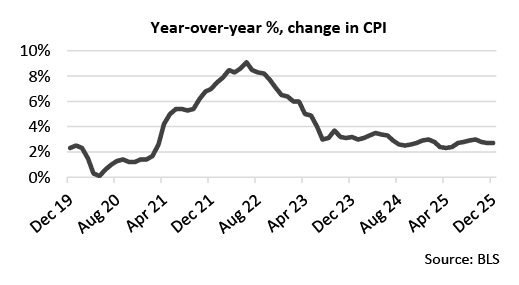
Historically, when activity re-accelerates from full employment, wage pressures and labour shortages tend to resurface. Under such conditions it would be difficult to argue monetary policy is restrictive. If wage growth strengthens, markets could begin to question whether further rate cuts are appropriate, or even whether we should see rate increases. If the labour market tightened further while the Fed continued to cut, questions around policy independence could become more relevant. Markets remain positioned for a smooth disinflation path, but a resurgence in inflation would trigger a rapid repricing of risk assets, making it a key issue that we continue to monitor very closely.
Historically, when activity re-accelerates from full employment, wage pressures and labour shortages tend to resurface. Under such conditions it would be difficult to argue monetary policy is restrictive. If wage growth strengthens, markets could begin to question whether further rate cuts are appropriate, or even whether we should see rate increases. If the labour market tightened further while the Fed continued to cut, questions around policy independence could become more relevant. Markets remain positioned for a smooth disinflation path, but a resurgence in inflation would trigger a rapid repricing of risk assets, making it a key issue that we continue to monitor very closely.
Earnings Momentum, Uneven Demand
Earnings Momentum, Uneven Demand
Earnings Momentum, Uneven Demand
A helpful way to reconcile resilient corporate earnings with visible pressures for many is the supposed two-speed K-shaped U.S. economy. But as some commentators have recently highlighted, this resilience is driven almost entirely by older generations, thus framing it as a “Gen-shaped” economy. Spending is sustained by Baby Boomers drawing down record wealth, while younger cohorts face significant affordability challenges. Baby Boomers are also supporting younger family members, which also masks the squeeze facing most other Gen Z and Millennials.
A helpful way to reconcile resilient corporate earnings with visible pressures for many is the supposed two-speed K-shaped U.S. economy.
A helpful way to reconcile resilient corporate earnings with visible pressures for many is the supposed two-speed K-shaped U.S. economy. But as some commentators have recently highlighted, this resilience is driven almost entirely by older generations, thus framing it as a “Gen-shaped” economy. Spending is sustained by Baby Boomers drawing down record wealth, while younger cohorts face significant affordability challenges. Baby Boomers are also supporting younger family members, which also masks the squeeze facing most other Gen Z and Millennials.
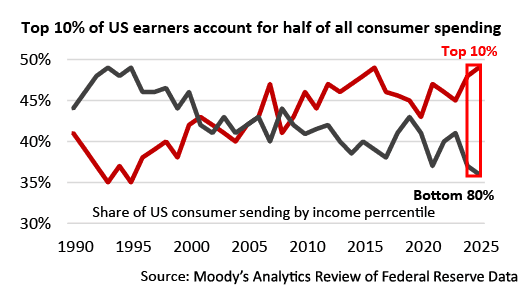
Affordability challenges also help explain why most consumer firms simply don’t have the pricing power to pass on tariff costs on to their customers. Instead, they are reluctantly absorbing these costs through lower profits, which helps explain why a tariff-led inflation spike has yet to materialise, to our surprise and the surprise of most economists.
But as some commentators have recently highlighted, this resilience is driven almost entirely by older generations, thus framing it as a “Gen-shaped” economy. Spending is sustained by Baby Boomers drawing down record wealth, while younger cohorts face significant affordability challenges. Baby Boomers are also supporting younger family members, which also masks the squeeze facing most other Gen Z and Millennials. Affordability challenges also help explain why most consumer firms simply don’t have the pricing power to pass on tariff costs on to their customers. Instead, they are reluctantly absorbing these costs through lower profits, which helps explain why a tariff-led inflation spike has yet to materialise, to our surprise and the surprise of most economists.
Affordability challenges also help explain why most consumer firms simply don’t have the pricing power to pass on tariff costs on to their customers. Instead, they are reluctantly absorbing these costs through lower profits, which helps explain why a tariff-led inflation spike has yet to materialise, to our surprise and the surprise of most economists.
Geopolitics & the U.S. Political Premium
Geopolitics & the U.S.
Political Premium
Geopolitics & the U.S. Political Premium
Geopolitical risks are clearly elevated as U.S. policy pivots toward a more aggressive stance. The recent extraction of President Maduro from Venezuela, coupled with more unsettling developments in Iran, has accelerated a broader sense of fragmentation in the global order. Yet the situation in Greenland stands out as a more unusual and potentially more consequential scenario involving critical alliances and strategic supply chains. Trump’s rhetoric regarding the territory’s value to U.S. national security has not only created friction with Denmark, but it also raises uncomfortable questions for NATO. The expectation is that diplomatic pressure will remain the dominant approach, consistent with the success of last years TACO trade (Trump Always Chicken Out), but Trump’s unpredictability carries a material risk that challenges the assumptions underpinning the post‑war order. There is a growing concern that recent events in Venezuela could encourage him to adopt a more interventionist course of action in Greenland as well.
Geopolitical risks are clearly elevated as U.S. policy pivots toward a more aggressive stance. The recent extraction of President Maduro from Venezuela, coupled with more unsettling developments in Iran, has accelerated a broader sense of fragmentation in the global order. Yet the situation in Greenland stands out as a more unusual and potentially more consequential scenario involving critical alliances and strategic supply chains. Trump’s rhetoric regarding the territory’s value to U.S. national security has not only created friction with Denmark, but it also raises uncomfortable questions for NATO. The expectation is that diplomatic pressure will remain the dominant approach, consistent with the success of last years TACO trade (Trump Always Chicken Out), but Trump’s unpredictability carries a material risk that challenges the assumptions underpinning the post‑war order. There is a growing concern that recent events in Venezuela could encourage him to adopt a more interventionist course of action in Greenland as well.
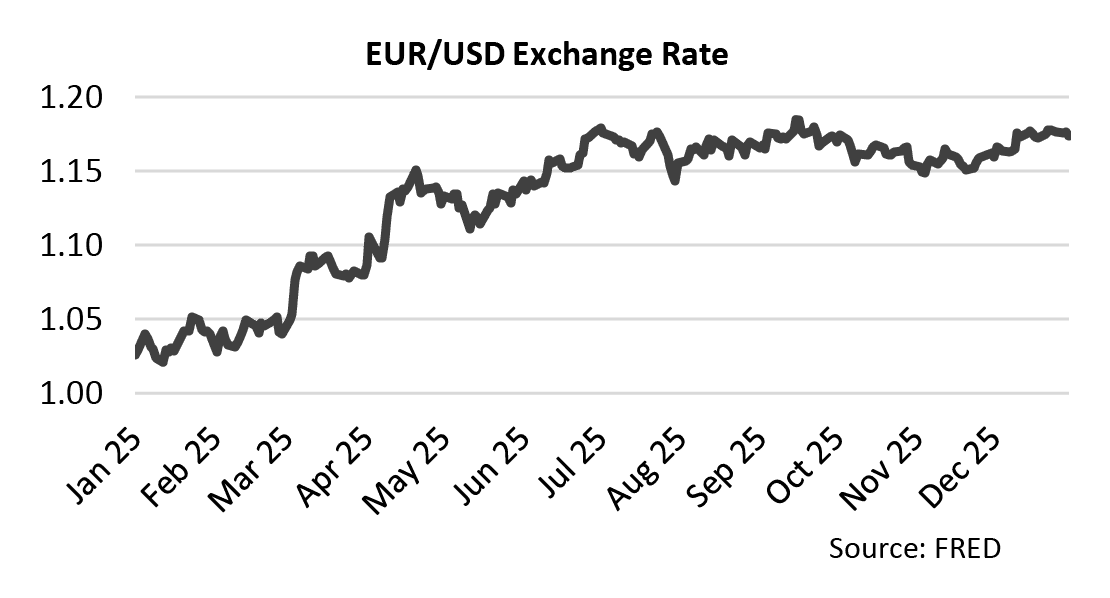
Renewed scrutiny on U.S. central bank independence, including the announced investigation into Fed Chair Jay Powell, is also an important risk to monitor because markets view Fed independence as a key anchor for confidence in U.S. policy and the dollar. If that confidence weakens, the dollar could become more volatile and less reliable as a safe haven. That matters for Irish investors because a weaker dollar can meaningfully reduce the euro value of U.S. assets, as it did in 2025.
Renewed scrutiny on U.S. central bank independence, including the announced investigation into Fed Chair Jay Powell, is also an important risk to monitor because markets view Fed independence as a key anchor for confidence in U.S. policy and the dollar. If that confidence weakens, the dollar could become more volatile and less reliable as a safe haven. That matters for Irish investors because a weaker dollar can meaningfully reduce the euro value of U.S. assets, as it did in 2025.
The AI Question: Boom or Bubble?
The AI Question: Boom or Bubble?
U.S. equity indices have become ever increasingly concentrated in a small group of large tech firms, leaving markets exposed if AI monetisation disappoints. The scale of AI investment is enormous and although it supports near-term earnings across its supply chain, the key question is whether a return on investment will be realised. There are signs of circularity, with hyperscalers funding AI developers who then spend heavily on cloud compute, helping to justify further infrastructure and chip purchases. We still need to see cash generated from outside the tech sector, through broad adoption in areas such as banking, healthcare, and manufacturing.
U.S. equity indices have become ever increasingly concentrated in a small group of large tech firms, leaving markets exposed if AI monetisation disappoints. The scale of AI investment is enormous and although it supports near-term earnings across its supply chain, the key question is whether a return on investment will be realised. There are signs of circularity, with hyperscalers funding AI developers who then spend heavily on cloud compute, helping to justify further infrastructure and chip purchases. We still need to see cash generated from outside the tech sector, through broad adoption in areas such as banking, healthcare, and manufacturing.
Nvidia’s rise to a $5 trillion market cap captures the sheer strength of the AI theme, and while its valuation is not extreme relative to its earnings, it operates at very high margins and relies on the hyperscalers continuing to spend (Microsoft, Alphabet, Meta, Amazon and Oracle). We see risks to the durability of these earnings, and recent advances from Alphabet and Amazon with their own chips highlight the obvious long-term challenges. For the hyperscalers themselves, AI has shifted their business models from capital-light to a more capital-intensive phase, as their aims for AI platform dominance have opened up competition with each other, whereas they had previously operated (and dominated) within their own clear lanes. A continued race to the bottom for market share will ultimately benefit end users. AI has the potential to benefit many other firms through higher productivity and lower costs, even though they are not currently part of the AI narrative.
Nvidia’s rise to a $5 trillion market cap captures the sheer strength of the AI theme, and while its valuation is not extreme relative to its earnings, it operates at very high margins and relies on the hyperscalers continuing to spend (Microsoft, Alphabet, Meta, Amazon and Oracle). We see risks to the durability of these earnings, and recent advances from Alphabet and Amazon with their own chips highlight the obvious long-term challenges. For the hyperscalers themselves, AI has shifted their business models from capital-light to a more capital-intensive phase, as their aims for AI platform dominance have opened up competition with each other, whereas they had previously operated (and dominated) within their own clear lanes. A continued race to the bottom for market share will ultimately benefit end users. AI has the potential to benefit many other firms through higher productivity and lower costs, even though they are not currently part of the AI narrative.
We remain mindful of the experience of the 2000s, where the dot com bubble burst in Q1 2000, even though internet company earnings didn’t start to decelerate until Q4 2000. This was a classic negative feedback loop (reflexivity), where lower share prices forced companies to cut capital expenditure, which in turn killed the revenue growth of their suppliers, pushing share prices even lower. A similar unwinding in the AI supply chain remains a key risk for 2026.
We remain mindful of the experience of the 2000s, where the dot com bubble burst in Q1 2000, even though internet company earnings didn’t start to decelerate until Q4 2000. This was a classic negative feedback loop (reflexivity), where lower share prices forced companies to cut capital expenditure, which in turn killed the revenue growth of their suppliers, pushing share prices even lower. A similar unwinding in the AI supply chain remains a key risk for 2026.
What this means for your investments in 2026
What this means for your investments in 2026
What this means for your investments in 2026
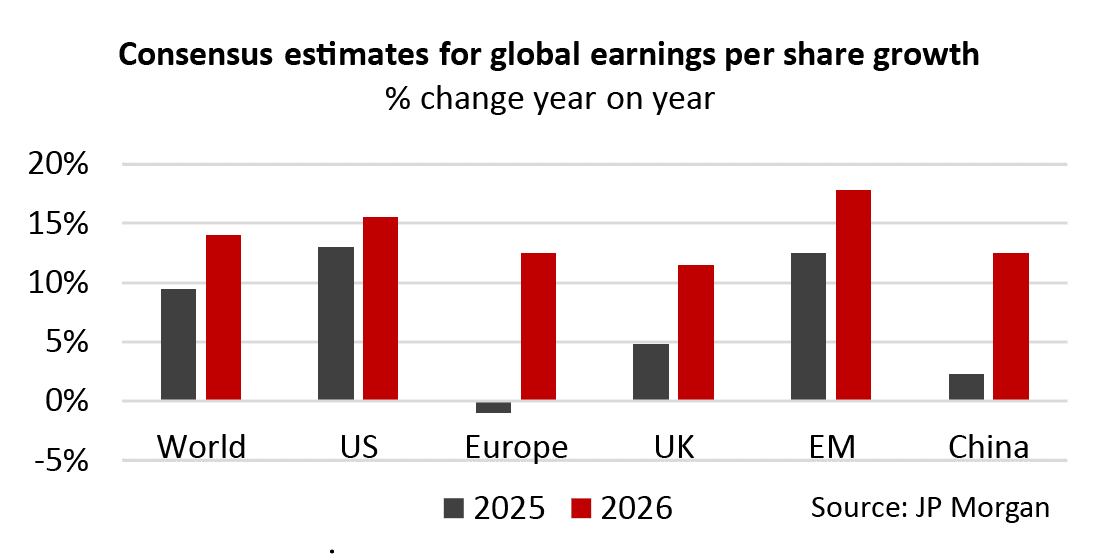
As highlighted, there are a number of known risks as we look ahead to 2026, but despite the obvious questions over AI, higher bond yields and U.S. trade policy, markets remain optimistic. Consensus equity analyst forecasts expect global equity earnings to grow at a double-digit rate across all regions in 2026, which is a very positive outlook. Current market valuations are however undoubtedly stretched by historical standards, so it is natural for investors to worry about an imminent correction.
As highlighted, there are a number of known risks as we look ahead to 2026, but despite the obvious questions over AI, higher bond yields and U.S. trade policy, markets remain optimistic. Consensus equity analyst forecasts expect global equity earnings to grow at a double-digit rate across all regions in 2026, which is a very positive outlook.
As highlighted, there are a number of known risks as we look ahead to 2026, but despite the obvious questions over AI, higher bond yields and U.S. trade policy, markets remain optimistic. Consensus equity analyst forecasts expect global equity earnings to grow at a double-digit rate across all regions in 2026, which is a very positive outlook.
However, we remember Peter Lynch’s famous quote that: “far more money has been lost by investors preparing for corrections, or trying to anticipate corrections, than has been lost in the corrections themselves”. There is obvious potential for volatility in the year ahead, whether from inflation scares, geopolitical flare-ups, or fatigue in the AI trade. Each risk calls for a different defence, so we aim to stay truly diversified and as long term investors we aim and encourage clients to use periods of price weakness to add risk to investment portfolios, rather than retreat from it.
Current market valuations are however undoubtedly stretched by historical standards, so it is natural for investors to worry about an imminent correction. However, we remember Peter Lynch’s famous quote that: “far more money has been lost by investors preparing for corrections, or trying to anticipate corrections, than has been lost in the corrections themselves”. There is obvious potential for volatility in the year ahead, whether from inflation scares, geopolitical flare-ups, or fatigue in the AI trade. Each risk calls for a different defence, so we aim to stay truly diversified and as long term investors we aim and encourage clients to use periods of price weakness to add risk to investment portfolios, rather than retreat from it.
Current market valuations are however undoubtedly stretched by historical standards, so it is natural for investors to worry about an imminent correction. However, we remember Peter Lynch’s famous quote that: “far more money has been lost by investors preparing for corrections, or trying to anticipate corrections, than has been lost in the corrections themselves”. There is obvious potential for volatility in the year ahead, whether from inflation scares, geopolitical flare-ups, or fatigue in the AI trade. Each risk calls for a different defence, so we aim to stay truly diversified and as long term investors we aim and encourage clients to use periods of price weakness to add risk to investment portfolios, rather than retreat from it.
The aim is not to predict the next drawdown. The aim is to own a portfolio that can absorb it and then continue to grow and compound afterwards. Cash can feel safe, but in a world where inflation is structurally higher than the last decade, holding too much cash becomes a steady loss of purchasing power. A better framework is to target risk-adjusted returns by: (i) accepting that price fluctuations are the price investors pay for real returns, (ii) diversifying so that no single outcome dominates future results, and (iii) staying anchored to fundamentals rather than to persistently evolving narratives.
The aim is not to predict the next drawdown. The aim is to own a portfolio that can absorb it and then continue to grow and compound afterwards. Cash can feel safe, but in a world where inflation is structurally higher than the last decade, holding too much cash becomes a steady loss of purchasing power. A better framework is to target risk-adjusted returns by: (i) accepting that price fluctuations are the price investors pay for real returns, (ii) diversifying so that no single outcome dominates future results, and (iii) staying anchored to fundamentals rather than to persistently evolving narratives.
Our most important portfolio message for 2026 is that we feel the next phase of markets is more likely to reward truly diversified portfolios rather than diversified funds in name only. Owning a world equity index has become an increasingly concentrated play on U.S. mega-cap tech and the AI cycle, alongside a currency dynamic that can work against euro-based returns. A more resilient approach is to intentionally diversify across regions, equity styles, and currencies. DFP investment portfolios benefited from this approach in 2025, and we expect the same principles to remain important in 2026 and beyond.
Our most important portfolio message for 2026 is that we feel the next phase of markets is more likely to reward truly diversified portfolios rather than diversified funds in name only. Owning a world equity index has become an increasingly concentrated play on U.S. mega-cap tech and the AI cycle, alongside a currency dynamic that can work against euro-based returns. A more resilient approach is to intentionally diversify across regions, equity styles, and currencies. DFP investment portfolios benefited from this approach in 2025, and we expect the same principles to remain important in 2026 and beyond.
Ciaran Carolan 09/01/2026
Ciaran Carolan 09/01/2026

At DFP, we offer financial management advice to individuals, charities, corporate partnerships and businesses, which is specifically designed around their individual circumstances.
Docal Ltd. t/a DFP Pension & Investment Consultants is regulated by the Central Bank of Ireland.
Registered Address: 1st Floor Quayside Business Park,
Mill Street, Dundalk, Co. Louth. Registered in Ireland, company registration number 390947
At DFP, we offer financial management advice to individuals, charities, corporate partnerships and businesses, which is specifically designed around their individual circumstances.
Docal Ltd. t/a DFP Pension & Investment Consultants is regulated by the Central Bank of Ireland.
Registered Address: 1st Floor Quayside Business Park,
Mill Street, Dundalk, Co. Louth. Registered in Ireland, company registration number 390947
At DFP, we offer financial management advice to individuals, charities, corporate partnerships and businesses, which is specifically designed around their individual circumstances.
Docal Ltd. t/a DFP Pension & Investment Consultants is regulated by the Central Bank of Ireland.
Registered Address: 1st Floor Quayside Business Park,
Mill Street, Dundalk, Co. Louth. Registered in Ireland, company registration number 390947