
Estimated read time: 5 mins
March 2026 Market Update
Middle East Escalation
Middle East Escalation
Our thoughts are first and foremost with the many innocent civilians caught up in this latest deeply troubling escalation in the Middle East.
Our thoughts are first and foremost with the many innocent civilians caught up in this latest deeply troubling escalation in the Middle East.
Over the weekend, the US and Israel launched joint airstrikes on Iran, killing several senior figures including Supreme Leader Ayatollah Ali Khamenei. President Trump called for regime change and indicated that strikes would continue for as long as necessary, although a senior White House official subsequently signalled openness to talks with any new Iranian leadership. Israel and Iran have continued to exchange fire, with casualties reported on both sides and Iranian-backed militias joining the fighting across the wider Middle East region. Missile and drone attacks have been reported near US-linked military bases, and major airlines in the region have halted flights, while shipping through the Strait of Hormuz has been disrupted. A drone attack on a Saudi refinery added concern, while Qatar has shut the world’s largest LNG export plant after attacks on its facilities. Energy prices have risen sharply, and global equity markets have opened lower today as investors assess the risks.
Over the weekend, the US and Israel launched joint airstrikes on Iran, killing several senior figures including Supreme Leader Ayatollah Ali Khamenei. President Trump called for regime change and indicated that strikes would continue for as long as necessary, although a senior White House official subsequently signalled openness to talks with any new Iranian leadership. Israel and Iran have continued to exchange fire, with casualties reported on both sides and Iranian-backed militias joining the fighting across the wider Middle East region. Missile and drone attacks have been reported near US-linked military bases, and major airlines in the region have halted flights, while shipping through the Strait of Hormuz has been disrupted. A drone attack on a Saudi refinery added concern, while Qatar has shut the world’s largest LNG export plant after attacks on its facilities. Energy prices have risen sharply, and global equity markets have opened lower today as investors assess the risks.
Euro Returns
Feb
Jan
YTD
Equities
MSCI World
1.5%
0.9%
2.4%
S&P 500
0.0%
0.1%
0.1%
EURO STOXX
3.5%
2.9%
6.5%
Nikkei 225
9.2%
6.1%
15.9%
MSCI UK
5.9%
3.8%
10%
MSCI EM
6.3%
7.5%
14.2%
MSCI China
-5.1%
3.4%
-1.9%
Government Bonds
US Treasuries
2.6%
-1.4%
1.2%
EUR Sovereigns
1.4%
0.7%
2.1%
Corporate Bonds
US High Grade
2.0%
-0.9%
1.1%
EUR High Grade
0.6%
0.8%
1.4%
Commodities
Commodity Index
3.2%
8.4%
11.8%
Oil (Crude)
3.8%
12.4%
16.8%
Copper
2.4%
4.4%
6.9%
Gold
11.8%
7.4%
20.1%
Currencies
EUR/USD
-0.8%
1.3%
0.5%
EUR/GBP
1.3%
-0.7%
0.6%
EUR/JPY
0.5%
-0.3%
0.1%
Euro Returns
Feb
Jan
YTD
MSCI World
1.5%
0.9%
2.4%
S&P 500
0.0%
0.1%
0.1%
EURO STOXX
3.5%
2.9%
6.5%
Nikkei 225
9.2%
6.1%
15.9%
MSCI UK
5.9%
3.8%
10.0%
MSCI EM
6.3%
7.5%
14.2%
MSCI China
-5.1%
3.4%
-1.9%
Equities
From an investment perspective, the most likely scenario is that any disruption to global energy supply will prove temporary. Initial oil price spikes following geopolitical shocks have historically faded once it becomes clear that critical infrastructure has not been severely damaged and that sustained large-scale military action is unlikely. This view is reinforced by the limited military capacity Iran is currently assessed to possess. Markets are usually volatile near term before refocusing on the positive underlying economic fundamentals. This pattern has held across most geopolitical shocks in recent decades, where sharp drawdowns have been followed by relatively swift recoveries once uncertainty recedes.
From an investment perspective, the most likely scenario is that any disruption to global energy supply will prove temporary. Initial oil price spikes following geopolitical shocks have historically faded once it becomes clear that critical infrastructure has not been severely damaged and that sustained large-scale military action is unlikely. This view is reinforced by the limited military capacity Iran is currently assessed to possess. Markets are usually volatile near term before refocusing on the positive underlying economic fundamentals. This pattern has held across most geopolitical shocks in recent decades, where sharp drawdowns have been followed by relatively swift recoveries once uncertainty recedes.
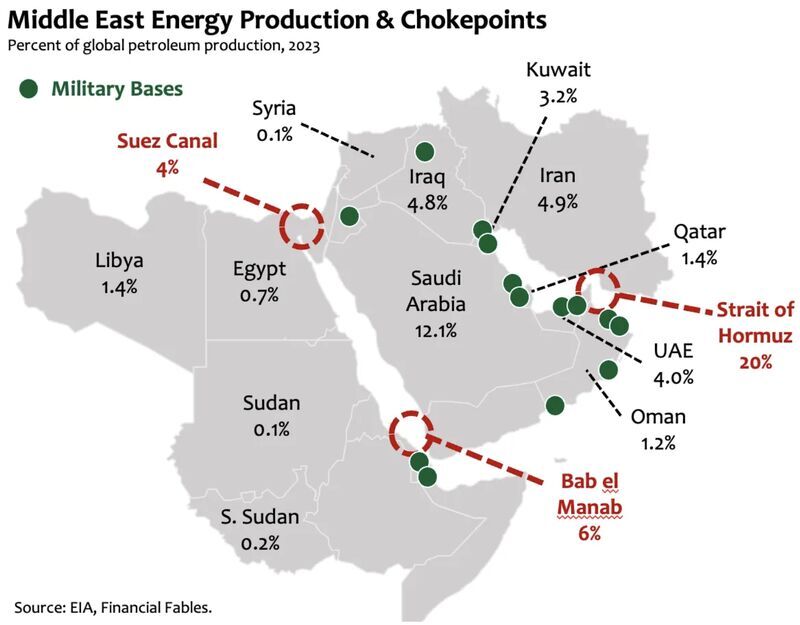
That said, the commencement of direct strikes between the US, Israel and Iran clearly raises the risk of a more severe outcome. A prolonged disruption to energy supplies would have a meaningful impact on global growth and inflation, as we saw during the Russia-Ukraine war in 2022. Iran's strategic importance is difficult to overstate, as it borders seven countries and sits at a critical global crossroads, with around 20% of the world's seaborne crude oil flowing through the Strait of Hormuz.
Importantly, Iran has so far stopped short of formally closing the Strait, even as tanker traffic has fallen sharply. A full closure would inflict severe damage on its own economy, as more than 80% of export revenues are derived from oil and gas. With most shipments transiting the Strait, such a move would also risk undermining Iran’s crucial relationship with China, its largest oil customer, for whom more than 40% of its crude imports pass through Hormuz. Iran accounts for less than 5% of global oil output, meaning the principal supply risk lies in potential broader damage to infrastructure and export capacity across other regional producers, rather than from Iranian production alone.
That said, the commencement of direct strikes between the US, Israel and Iran clearly raises the risk of a more severe outcome. A prolonged disruption to energy supplies would have a meaningful impact on global growth and inflation, as we saw during the Russia-Ukraine war in 2022. Iran's strategic importance is difficult to overstate, as it borders seven countries and sits at a critical global crossroads, with around 20% of the world's seaborne crude oil flowing through the Strait of Hormuz.
Importantly, Iran has so far stopped short of formally closing the Strait, even as tanker traffic has fallen sharply. A full closure would inflict severe damage on its own economy, as more than 80% of export revenues are derived from oil and gas. With most shipments transiting the Strait, such a move would also risk undermining Iran’s crucial relationship with China, its largest oil customer, for whom more than 40% of its crude imports pass through Hormuz. Iran accounts for less than 5% of global oil output, meaning the principal supply risk lies in potential broader damage to infrastructure and export capacity across other regional producers, rather than from Iranian production alone.
The US is in a materially stronger strategic position than during the oil shocks in the 1970s & 80s, having emerged as the world's largest energy producer, accounting for c.20% of global oil supply and leading global natural gas production. This energy independence has reduced its economic vulnerability to Middle Eastern supply disruptions, though any upward pressure on fuel prices will be a political sensitivity for the Trump administration ahead of November's mid-term elections. Europe is considerably more exposed, as it sources a significant share of its oil and diesel imports from the Middle East.
The US is in a materially stronger strategic position than during the oil shocks in the 1970s & 80s, having emerged as the world's largest energy producer, accounting for c.20% of global oil supply and leading global natural gas production. This energy independence has reduced its economic vulnerability to Middle Eastern supply disruptions, though any upward pressure on fuel prices will be a political sensitivity for the Trump administration ahead of November's mid-term elections. Europe is considerably more exposed, as it sources a significant share of its oil and diesel imports from the Middle East.
One of the defining themes of 2026 has been the outperformance of developed ex-US and EM equities relative to US equities, a trend supported by a weaker dollar. Near-term dollar strength remains a risk, should higher energy prices feed into inflation and constrain the Fed's ability to cut rates. We view this as more of a short-term headwind, and remain constructive on the international theme over the longer term.
One of the defining themes of 2026 has been the outperformance of developed ex-US and EM equities relative to US equities, a trend supported by a weaker dollar. Near-term dollar strength remains a risk, should higher energy prices feed into inflation and constrain the Fed's ability to cut rates. We view this as more of a short-term headwind, and remain constructive on the international theme over the longer term.
The broader market backdrop continues to be supported by solid economic growth, resilient corporate earnings, and elevated levels of fiscal spending globally. Historically, making rapid decisions during periods of geopolitical stress has not been a profitable strategy. Instead, investors have been better served by maintaining a long-term focus and remaining invested. We do not try to predict outcomes, instead we focus on managing risks by constructing diversified portfolios that can withstand a range of outcomes. For clients with a keen focus on capital preservation, this environment reinforces the role of defensive assets.
The broader market backdrop continues to be supported by solid economic growth, resilient corporate earnings, and elevated levels of fiscal spending globally. Historically, making rapid decisions during periods of geopolitical stress has not been a profitable strategy. Instead, investors have been better served by maintaining a long-term focus and remaining invested. We do not try to predict outcomes, instead we focus on managing risks by constructing diversified portfolios that can withstand a range of outcomes. For clients with a keen focus on capital preservation, this environment reinforces the role of defensive assets.
Events like this also serve as a reminder that volatility, while unsettling, can present an opportunity to deploy capital at more attractive valuations. While we remain very mindful of the humanitarian devastation unfolding, for longer-term investors, periods of market stress have historically rewarded patience and discipline over reaction.
Events like this also serve as a reminder that volatility, while unsettling, can present an opportunity to deploy capital at more attractive valuations. While we remain very mindful of the humanitarian devastation unfolding, for longer-term investors, periods of market stress have historically rewarded patience and discipline over reaction.
Ciaran Carolan 02/03/2026

At DFP, we offer financial management advice to individuals, charities, corporate partnerships and businesses, which is specifically designed around their individual circumstances.
Docal Ltd. t/a DFP Pension & Investment Consultants is regulated by the Central Bank of Ireland.
Registered Address: 1st Floor Quayside Business Park,
Mill Street, Dundalk, Co. Louth. Registered in Ireland, company registration number 390947
At DFP, we offer financial management advice to individuals, charities, corporate partnerships and businesses, which is specifically designed around their individual circumstances.
Docal Ltd. t/a DFP Pension & Investment Consultants is regulated by the Central Bank of Ireland.
Registered Address: 1st Floor Quayside Business Park,
Mill Street, Dundalk, Co. Louth. Registered in Ireland, company registration number 390947
At DFP, we offer financial management advice to individuals, charities, corporate partnerships and businesses, which is specifically designed around their individual circumstances.
Docal Ltd. t/a DFP Pension & Investment Consultants is regulated by the Central Bank of Ireland.
Registered Address: 1st Floor Quayside Business Park,
Mill Street, Dundalk, Co. Louth. Registered in Ireland, company registration number 390947