
Estimated read time: 7 mins
Q3 Quarterly Report 2025
Earnings Over Everything
Earnings Over Everything
Global stock markets posted robust gains in the third quarter, with the MSCI World index delivering a 7.3% return in euro terms. The dominant U.S. market was supported by a very reassuring Q2 earnings season, with over 80% of S&P 500 companies beating expectations, and overall earnings rising by 10.7% year-on-year (versus an estimated 6%). Once again tech earnings were strongest, with the Magnificent 7 contributing 52% of the yearly earnings growth, justifying their elevated valuations in the near term. Alphabet (Google) rose 37% while NVIDIA became the first company to surpass a €4 trillion market cap. Corporate earnings remain the key link between the real economy and equity markets, and once again these strong results reassured investors - for now.
Global stock markets posted robust gains in the third quarter, with the MSCI World index delivering a 7.3% return in euro terms. The dominant U.S. market was supported by a very reassuring Q2 earnings season, with over 80% of S&P 500 companies beating expectations, and overall earnings rising by 10.7% year-on-year (versus an estimated 6%). Once again tech earnings were strongest, with the Magnificent 7 contributing 52% of the yearly earnings growth, justifying their elevated valuations in the near term. Alphabet (Google) rose 37% while NVIDIA became the first company to surpass a €4 trillion market cap. Corporate earnings remain the key link between the real economy and equity markets, and once again these strong results reassured investors - for now.
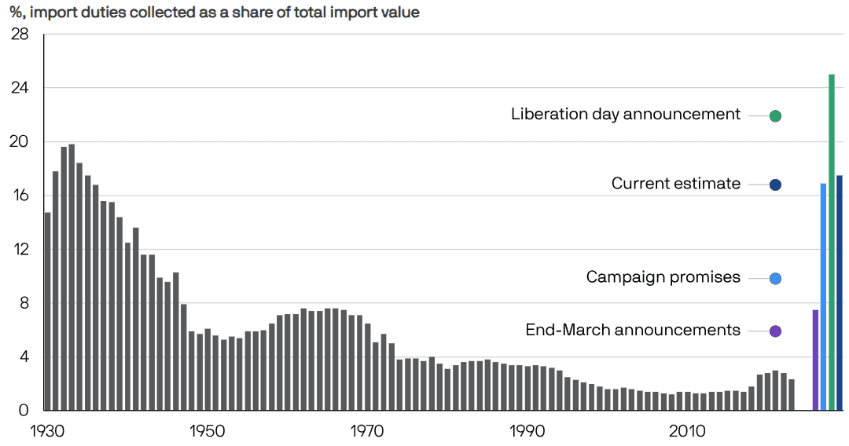
After months of shifting announcements, reversals, and changing targets, Trump’s long-threatened tariffs on major trading partners were finally implemented in August. Since then, the narrative has largely been one of triumph for Trump, as his aggressive approach has resulted in an effective U.S. tariff rate of around 17%, which is significantly higher than his campaign promises and far beyond what most expected at the start of the year. While we are not yet seeing a direct impact from tariffs on earnings or inflation, most corporate management teams noted during recent earnings calls that they are reassessing supply chains, pricing strategies, capital expenditures, and hiring plans.
After months of shifting announcements, reversals, and changing targets, Trump’s long-threatened tariffs on major trading partners were finally implemented in August. Since then, the narrative has largely been one of triumph for Trump, as his aggressive approach has resulted in an effective U.S. tariff rate of around 17%, which is significantly higher than his campaign promises and far beyond what most expected at the start of the year. While we are not yet seeing a direct impact from tariffs on earnings or inflation, most corporate management teams noted during recent earnings calls that they are reassessing supply chains, pricing strategies, capital expenditures, and hiring plans.
Sep
Aug
July
Q3
YTD
Equities
MSCI World
3.2%
2.6%
1.3%
7.3%
17.4%
S&P 500
3.6%
2.0%
2.2%
8.0%
14.5%
EURO STOXX
2.8%
0.3%
1.0%
4.2%
18.9%
Nikkei 225
5.7%
4.1%
1.4%
11.6%
14.3%
MSCI UK
1.6%
1.5%
4.4%
7.8%
17.5%
MSCI EM
7.2%
1.3%
2.0%
10.6%
27.5%
MSCI China
9.5%
4.1%
5.2%
19.9%
38.1%
Government Bonds
US Treasuries
0.9%
1.1%
-0.4%
1.5%
5.3%
EUR Sovereigns
0.5%
-0.5%
-0.2%
-0.2%
0.3%
Corporate Bonds
US High Grade
1.4%
1.1%
0.2%
2.7%
7.0%
EUR High Grade
0.4%
0.0%
0.5%
0.9%
2.8%
Commodities
Commodity Index
0.7%
-0.2%
3.6%
4.1%
6.1%
Oil (Crude)
-2.1%
-6.4%
8.5%
-0.6%
-4.9%
Copper
4.0%
3.0%
-2.8%
4.1%
20.3%
Gold
10.5%
5.4%
-0.1%
16.4%
44.8%
Currencies
EUR/USD
0.4%
2.3%
-2.5%
0.1%
13.5%
EUR/GBP
0.7%
0.2%
1.0%
1.9%
5.6%
EUR/JPY
1.0%
-0.2%
1.6%
2.3%
6.6%
Jun
May
Apr
Q2
YTD
MSCI World
3.2%
2.6%
1.3%
7.3%
17.4%
S&P 500
3.6%
2.0%
2.2%
8.0%
14.5%
EURO STOXX
2.8%
0.3%
1.0%
4.2%
18.9%
Nikkei 225
5.7%
4.1%
1.4%
11.6%
14.3%
MSCI UK
1.6%
1.5%
4.4%
7.8%
17.5%
MSCI EM
7.2%
1.3%
2.0%
10.6%
27.5%
MSCI China
9.5%
4.1%
5.2%
19.9%
38.1%
Equities
While headlines suggest most trading partners have caved to Trump, tariff costs will fall mainly on U.S. consumers and businesses, not foreign exporters. Higher tariffs risk slowing growth, lifting goods inflation, and dampening demand in the U.S. as companies pass on costs. Rising input prices and trade uncertainty are prompting firms to delay hiring and investment, as reflected in the recent decline in ISM business survey data. Tariffs function like a tax, but much will depend on how much of the cost is eventually passed to consumers and whether firms move from pausing recruitment to cutting jobs.
While headlines suggest most trading partners have caved to Trump, tariff costs will fall mainly on U.S. consumers and businesses, not foreign exporters. Higher tariffs risk slowing growth, lifting goods inflation, and dampening demand in the U.S. as companies pass on costs. Rising input prices and trade uncertainty are prompting firms to delay hiring and investment, as reflected in the recent decline in ISM business survey data. Tariffs function like a tax, but much will depend on how much of the cost is eventually passed to consumers and whether firms move from pausing recruitment to cutting jobs.
U.S. Labour Market
U.S. Labour Market
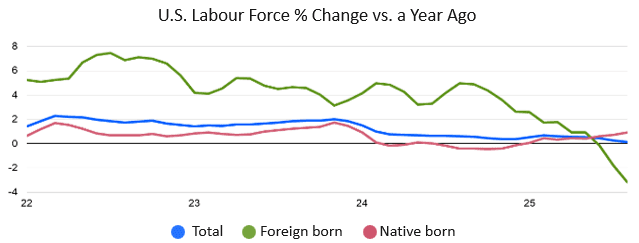
This is partly explained by fewer workers quitting their jobs, as many found jobs more suited to their skills and interests during the pandemic. The lack of quitting also increasingly reflects caution from workers that they may not find another job quickly. Hiring has also slowed because of labour supply, as employers are struggling to find workers due to stricter immigration policies. The CBO now expects net immigration of 400,000 in 2025 versus a January estimate of 2 million. Although native-born participation has risen slightly, the overall labour force remains stagnant because of the pressures on immigrant workers.
This is partly explained by fewer workers quitting their jobs, as many found jobs more suited to their skills and interests during the pandemic. The lack of quitting also increasingly reflects caution from workers that they may not find another job quickly. Hiring has also slowed because of labour supply, as employers are struggling to find workers due to stricter immigration policies. The CBO now expects net immigration of 400,000 in 2025 versus a January estimate of 2 million. Although native-born participation has risen slightly, the overall labour force remains stagnant because of the pressures on immigrant workers.
Consumer spending drives hiring, and spending by the bottom 80% of households has barely kept pace with inflation. With limited savings and rising debt payments, there’s little room for a rebound. The top 20% have continued to spend more freely, but they account for a smaller share of labour-driven demand. Despite all this, layoffs remain low. Tech companies are cutting jobs as they look to benefit from AI, but businesses are generally holding onto workers.
Consumer spending drives hiring, and spending by the bottom 80% of households has barely kept pace with inflation. With limited savings and rising debt payments, there’s little room for a rebound. The top 20% have continued to spend more freely, but they account for a smaller share of labour-driven demand. Despite all this, layoffs remain low. Tech companies are cutting jobs as they look to benefit from AI, but businesses are generally holding onto workers.
So far, businesses seem reluctant to lay off workers so soon after the pandemic-era labour shortages, with hiring freezes being used as a less disruptive way to manage costs. If demand weakens further, layoffs may follow. Typically, once one firm in an industry starts cutting, others often follow quickly. That is when unemployment claims spike, confidence collapses, and recession sets in. The key question is whether an economy can continue shedding jobs without those losses spreading and triggering a full economic recession. The likelihood is that the jobs market will remain in a low hiring/low firing state. Unemployment claims continue to trend below 250,000, well under the 300,000 per week threshold typically associated with economic recession.
So far, businesses seem reluctant to lay off workers so soon after the pandemic-era labour shortages, with hiring freezes being used as a less disruptive way to manage costs. If demand weakens further, layoffs may follow. Typically, once one firm in an industry starts cutting, others often follow quickly. That is when unemployment claims spike, confidence collapses, and recession sets in. The key question is whether an economy can continue shedding jobs without those losses spreading and triggering a full economic recession. The likelihood is that the jobs market will remain in a low hiring/low firing state. Unemployment claims continue to trend below 250,000, well under the 300,000 per week threshold typically associated with economic recession.
AI Capex Boom
AI Capex Boom
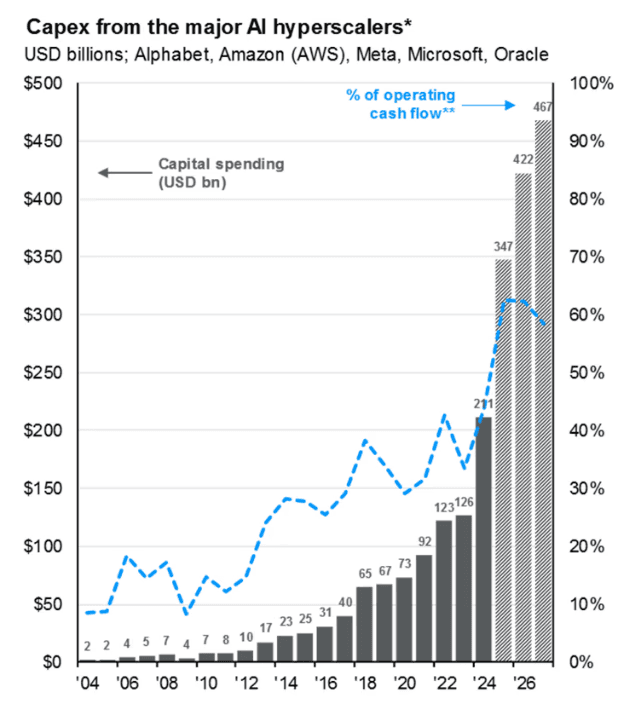
As traditional sectors grapple with labour market headwinds, tech companies are doubling down on capex investment, as part of their big bet that innovation will drive the next phase of growth. AI spending by just Amazon, Meta, Alphabet, and Microsoft is set to account for 8% of total U.S. fixed business investment, with the level of investment rising sharply both in dollar terms and as a share of their operating cash flow. Returns on that investment are not yet evident and any signs of a slowdown could trigger significant market volatility. In particular, there is a growing discussion around the circular nature of investment and revenue in the AI ecosystem.
For example, NVIDIA invests in OpenAI, which in turn buys large volumes of NVIDIA’s chips. This raises the question of whether the strength in tech earnings is being driven by internal flows within the sector, rather than external demand.
As traditional sectors grapple with labour market headwinds, tech companies are doubling down on capex investment, as part of their big bet that innovation will drive the next phase of growth. AI spending by just Amazon, Meta, Alphabet, and Microsoft is set to account for 8% of total U.S. fixed business investment, with the level of investment rising sharply both in dollar terms and as a share of their operating cash flow. Returns on that investment are not yet evident and any signs of a slowdown could trigger significant market volatility. In particular, there is a growing discussion around the circular nature of investment and revenue in the AI ecosystem.
For example, NVIDIA invests in OpenAI, which in turn buys large volumes of NVIDIA’s chips. This raises the question of whether the strength in tech earnings is being driven by internal flows within the sector, rather than external demand.
As traditional sectors grapple with labour market headwinds, tech companies are doubling down on capex investment, as part of their big bet that innovation will drive the next phase of growth. AI spending by just Amazon, Meta, Alphabet, and Microsoft is set to account for 8% of total U.S. fixed business investment, with the level of investment rising sharply both in dollar terms and as a share of their operating cash flow. Returns on that investment are not yet evident and any signs of a slowdown could trigger significant market volatility. In particular, there is a growing discussion around the circular nature of investment and revenue in the AI ecosystem.
The long-standing bull case for tech has been that these companies are generating exceptional earnings, unlike the early 2000s when valuations were based more on hope rather than actual profitability.
But we also need to ask who is the true end buyer of these technologies. If the demand is largely coming from within the tech sector itself, the sustainability of these earnings could be at risk. Ideally, we want to see wider enterprise adoption, with banks, healthcare and manufacturers making meaningful investments in AI because it delivers real value, instead of just tech companies. If AI becomes primarily a consumer-facing technology, the monetisation potential could be more limited.
The long-standing bull case for tech has been that these companies are generating exceptional earnings, unlike the early 2000s when valuations were based more on hope rather than actual profitability.
But we also need to ask who is the true end buyer of these technologies. If the demand is largely coming from within the tech sector itself, the sustainability of these earnings could be at risk. Ideally, we want to see wider enterprise adoption, with banks, healthcare and manufacturers making meaningful investments in AI because it delivers real value, instead of just tech companies. If AI becomes primarily a consumer-facing technology, the monetisation potential could be more limited.
For example, NVIDIA invests in OpenAI, which in turn buys large volumes of NVIDIA’s chips. This raises the question of whether the strength in tech earnings is being driven by internal flows within the sector, rather than external demand. The long-standing bull case for tech has been that these companies are generating exceptional earnings, unlike the early 2000s when valuations were based more on hope rather than actual profitability.
But we also need to ask who is the true end buyer of these technologies. If the demand is largely coming from within the tech sector itself, the sustainability of these earnings could be at risk. Ideally, we want to see wider enterprise adoption, with banks, healthcare and manufacturers making meaningful investments in AI because it delivers real value, instead of just tech companies. If AI becomes primarily a consumer-facing technology, the monetisation potential could be more limited.
Right now, companies like OpenAI are making large capex commitments based on the belief that future use cases will emerge. This signals to the market that more infrastructure is needed, which justifies continued investment, and so the cycle continues. But for this to be sustainable, we need to see real cash flow generation from outside the tech sector. Many companies are still in the exploratory phase, as they invest to explore AI’s potential, but we need clearer evidence that AI is driving revenue growth or cost savings. That is what will give us greater confidence in the long-term trajectory of these investments and the broader AI ecosystem.
Right now, companies like OpenAI are making large capex commitments based on the belief that future use cases will emerge. This signals to the market that more infrastructure is needed, which justifies continued investment, and so the cycle continues. But for this to be sustainable, we need to see real cash flow generation from outside the tech sector. Many companies are still in the exploratory phase, as they invest to explore AI’s potential, but we need clearer evidence that AI is driving revenue growth or cost savings. That is what will give us greater confidence in the long-term trajectory of these investments and the broader AI ecosystem.
Gold Keeps Shining Bright
One Big
Beautiful Bill
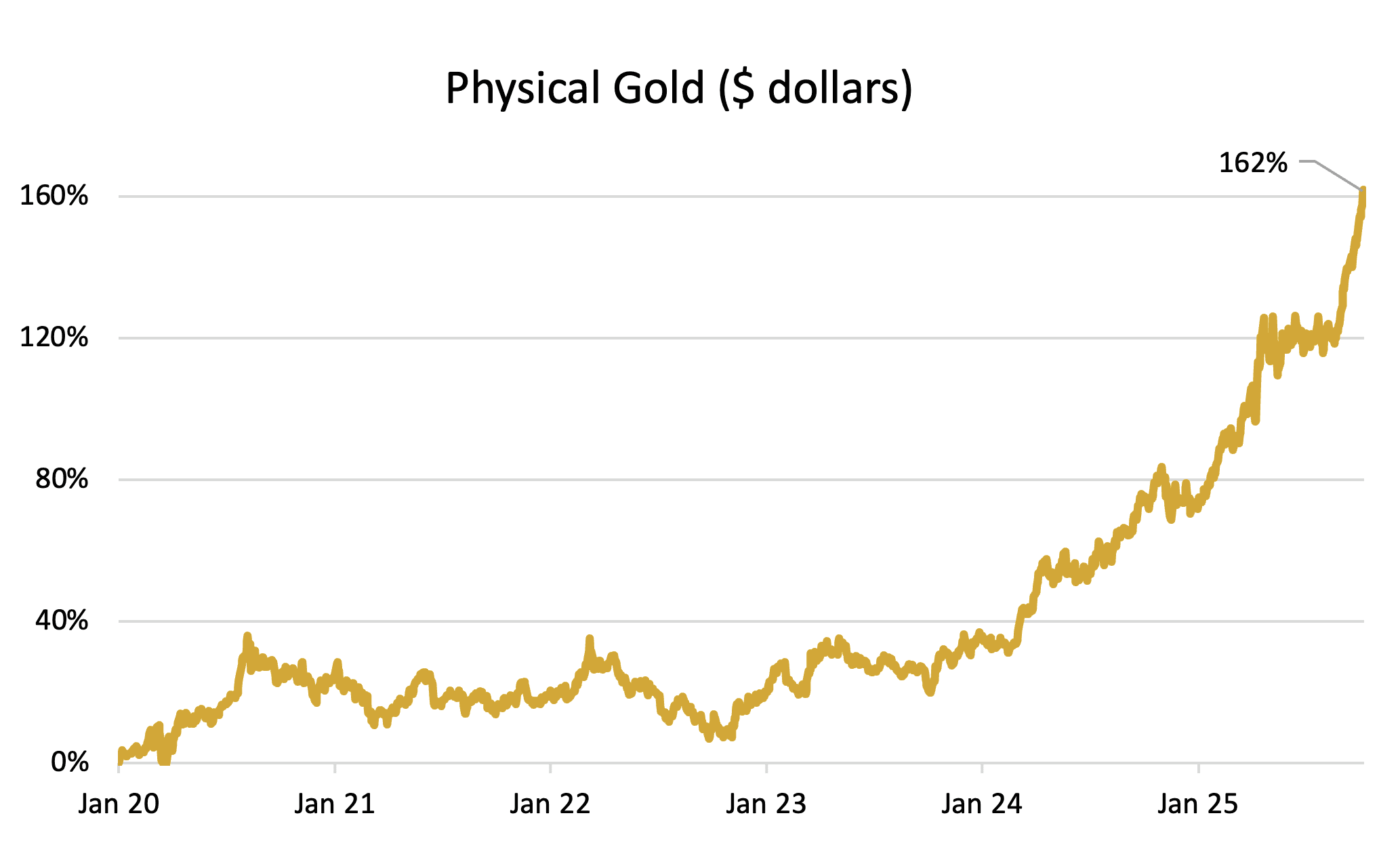
The new U.S. administration’s policies are reshaping the global economy and have already contributed to a much weaker dollar and increased the risk of higher inflation. Both factors significantly impact asset performance, not least the price of Gold, which is on track for its strongest annual gain in more than three decades as it approaches $4,000-an-ounce. This move seems at odds with the S&P 500’s continued march higher, but gold is supported by several key forces:
The new U.S. administration’s policies are reshaping the global economy and have already contributed to a much weaker dollar and increased the risk of higher inflation. Both factors significantly impact asset performance, not least the price of Gold, which is on track for its strongest annual gain in more than three decades as it approaches $4,000-an-ounce. This move seems at odds with the S&P 500’s continued march higher, but gold is supported by several key forces:
Gold acts as a hedge against inflation and financial crises, which are clear risks today. Rising global bond yields reflect concerns over the sustainability of high-spending, low-growth economies and likelihood governments will inflate away their vast levels of debt.
Gold acts as a hedge against inflation and financial crises, which are clear risks today. Rising global bond yields reflect concerns over the sustainability of high-spending, low-growth economies and likelihood governments will inflate away their vast levels of debt.
Sanctions on Russia, including the freezing of its foreign reserves, have unsettled other nations, prompting a shift toward gold as a hedge outside the global banking system.
Sanctions on Russia, including the freezing of its foreign reserves, have unsettled other nations, prompting a shift toward gold as a hedge outside the global banking system.
Continued geopolitical tensions and growing doubts over the dollar’s reserve currency status have driven broader central bank demand, which is likely to persist as nations diversify away from dollar.
Continued geopolitical tensions and growing doubts over the dollar’s reserve currency status have driven broader central bank demand, which is likely to persist as nations diversify away from dollar.
Investor participation in this bull run has been limited (evidenced by ETF holdings), and this is especially true for retail investors as they have generally favoured crypto. If institutional and retail investors begin to follow central banks, it could spark a fresh wave of demand.
Investor participation in this bull run has been limited (evidenced by ETF holdings), and this is especially true for retail investors as they have generally favoured crypto. If institutional and retail investors begin to follow central banks, it could spark a fresh wave of demand.
With production around $1,500 per ounce, the current price is also well above cost, which creates a very favourable dynamic for gold miners as they can earn record profit margins of around $2,500 per ounce. Despite very strong year-to-date performance, gold miners still lag the metal, in a trend that has persisted since 2013. Gold mining profits are highly leveraged to price movements due to fixed costs and debt, amplifying gains during rallies but also losses in downturns. Although there have already been big moves this year, the rally could have room to run as the Fed prepares to ease.
With production around $1,500 per ounce, the current price is also well above cost, which creates a very favourable dynamic for gold miners as they can earn record profit margins of around $2,500 per ounce. Despite very strong year-to-date performance, gold miners still lag the metal, in a trend that has persisted since 2013. Gold mining profits are highly leveraged to price movements due to fixed costs and debt, amplifying gains during rallies but also losses in downturns. Although there have already been big moves this year, the rally could have room to run as the Fed prepares to ease.
Silver also presents an intriguing opportunity, as one ounce of gold can buy 83 ounces of silver, well above the long-term average of 58, making silver appear undervalued relative to gold despite its own recent strong gains. Silver is used in a range of industrial processes, and the rapid growth of green energy worldwide has driven strong demand from the solar panel industry, which is likely to persist. This industrial exposure means silver typically carries more business cycle risk than gold, which requires monitoring. More broadly, the appeal of assets with a finite supply (such as hard commodities, real estate, or infrastructure) is rising in today’s increasingly fragmented global economic environment.
Silver also presents an intriguing opportunity, as one ounce of gold can buy 83 ounces of silver, well above the long-term average of 58, making silver appear undervalued relative to gold despite its own recent strong gains. Silver is used in a range of industrial processes, and the rapid growth of green energy worldwide has driven strong demand from the solar panel industry, which is likely to persist. This industrial exposure means silver typically carries more business cycle risk than gold, which requires monitoring. More broadly, the appeal of assets with a finite supply (such as hard commodities, real estate, or infrastructure) is rising in today’s increasingly fragmented global economic environment.
Ciaran Carolan 10/10/2025
Ciaran Carolan 10/10/2025

At DFP, we offer financial management advice to individuals, charities, corporate partnerships and businesses, which is specifically designed around their individual circumstances.
Docal Ltd. t/a DFP Pension & Investment Consultants is regulated by the Central Bank of Ireland.
Registered Address: 1st Floor Quayside Business Park,
Mill Street, Dundalk, Co. Louth. Registered in Ireland, company registration number 390947
At DFP, we offer financial management advice to individuals, charities, corporate partnerships and businesses, which is specifically designed around their individual circumstances.
Docal Ltd. t/a DFP Pension & Investment Consultants is regulated by the Central Bank of Ireland.
Registered Address: 1st Floor Quayside Business Park,
Mill Street, Dundalk, Co. Louth. Registered in Ireland, company registration number 390947
At DFP, we offer financial management advice to individuals, charities, corporate partnerships and businesses, which is specifically designed around their individual circumstances.
Docal Ltd. t/a DFP Pension & Investment Consultants is regulated by the Central Bank of Ireland.
Registered Address: 1st Floor Quayside Business Park,
Mill Street, Dundalk, Co. Louth. Registered in Ireland, company registration number 390947