
Estimated read time: 7 mins
Q2 Quarterly Report 2025
Trump Tariff Tantrum
Trump Tariff Tantrum
A quick glance at the returns for the main global equity indices in Q2 suggests a relatively uneventful quarter, but in fact, it was anything but.
A quick glance at the returns for the main global equity indices in Q2 suggests a relatively uneventful quarter, but in fact, it was anything but.
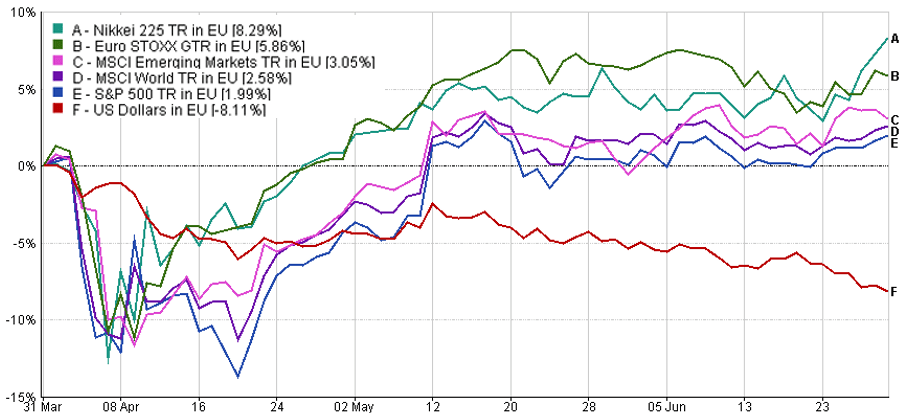
Equity markets sold off sharply on April 2nd, after President Trump unveiled his tariff plans during the now-infamous Rose Garden event. This was one of the steepest selloffs in equity market history and the dollar also retreated against its major peers, even though it is usually a safe-haven asset. Yet it was the volatility in the bond market that persuaded Trump to pause his contentious plans, and this retreat sparked an equally dramatic recovery. The rebound was led by the parts of the market that had suffered the most, with U.S. tech climbing over 30% from its April 8th low. Interestingly, the U.S. dollar did not join in on the recovery, as concerns about the new administration’s chaotic policy mix led to a continued decline for the greenback. This currency weakness offset a lot of US equity gains, meaning the S&P 500 trailed the other major global markets for a second consecutive quarter, in euro terms.
Equity markets sold off sharply on April 2nd, after President Trump unveiled his tariff plans during the now-infamous Rose Garden event. This was one of the steepest selloffs in equity market history and the dollar also retreated against its major peers, even though it is usually a safe-haven asset. Yet it was the volatility in the bond market that persuaded Trump to pause his contentious plans, and this retreat sparked an equally dramatic recovery. The rebound was led by the parts of the market that had suffered the most, with U.S. tech climbing over 30% from its April 8th low. Interestingly, the U.S. dollar did not join in on the recovery, as concerns about the new administration’s chaotic policy mix led to a continued decline for the greenback. This currency weakness offset a lot of US equity gains, meaning the S&P 500 trailed the other major global markets for a second consecutive quarter, in euro terms.
Jun
May
Apr
Q2
YTD
Equities
MSCI World
4.3%
5.9%
0.9%
11.5%
9.5%
S&P 500
5.1%
6.3%
-0.7%
10.8%
6.0%
EURO STOXX
-0.6%
6.0%
0.4%
5.9%
14.1%
Nikkei 225
6.8%
5.3%
1.2%
13.8%
2.4%
MSCI UK
-0.2%
3.4%
-0.8%
2.4%
9.0%
MSCI EM
6.0%
4.3%
1.3%
12.0%
15.3%
MSCI China
3.3%
1.8%
-4.1%
0.8%
15.2%
Government Bonds
US Treasuries
1.3%
-1.0%
0.6%
0.8%
3.7%
EUR Sovereigns
-0.2%
0.1%
2.0%
1.9%
0.5%
Corporate Bonds
US High Grade
1.8%
0.0%
0.0%
1.8%
4.2%
EUR High Grade
0.2%
0.5%
0.9%
1.7%
1.8%
Commodities
Commodity Index
11.7%
1.6%
-8.4%
3.9%
9.0%
Oil (Crude)
9.0%
5.1%
-17.9%
-6.0%
-4.4%
Copper
1.9%
4.8%
-5.4%
1.0%
12.6%
Gold
3.0%
-0.6%
5.7%
8.3%
28.0%
Currencies
EUR/USD
3.4%
-0.1%
5.2%
8.7%
13.4%
EUR/GBP
1.8%
-1.1%
1.7%
2.4%
3.6%
EUR/JPY
3.5%
1.0%
0.4%
5.0%
4.2%
Jun
May
Apr
Q2
YTD
MSCI World
4.3%
5.9%
0.9%
11.5%
9.5%
S&P 500
5.1%
6.3%
-0.7%
10.8%
6.0%
EURO STOXX
-0.6%
6.0%
0.4%
5.9%
14.1%
Nikkei 225
6.8%
5.3%
1.2%
13.8%
2.4%
MSCI UK
-0.2%
3.4%
-0.8%
2.4%
9.0%
MSCI EM
6.0%
4.3%
1.3%
12.0%
15.3%
MSCI China
3.3%
1.8%
-4.1%
0.8%
15.2%
Equities
Markets Remain Steady Amid Brief Israel–Iran Conflict
Markets Remain Steady Amid Brief Israel–Iran Conflict
Middle East Tension
Middle East Tension
Equity markets have shown remarkable resilience over the last few years as they have become increasingly comfortable adjusting to the steady stream of emerging risks, including the recent escalation between Israel and Iran. Following Israeli airstrikes beginning June 13th, the U.S. entered the conflict on June 22nd with targeted attacks on Iranian nuclear sites. The escalation drew threats from Iran and its allies, but eventually, Iran just responded with a symbolic missile strike on a U.S. base in Qatar. Trump thanked Iran for their “very weak” response, announcing a ceasefire shortly after and branding the conflict as the “12-day war”.
Equity markets have shown remarkable resilience over the last few years as they have become increasingly comfortable adjusting to the steady stream of emerging risks, including the recent escalation between Israel and Iran. Following Israeli airstrikes beginning June 13th, the U.S. entered the conflict on June 22nd with targeted attacks on Iranian nuclear sites. The escalation drew threats from Iran and its allies, but eventually, Iran just responded with a symbolic missile strike on a U.S. base in Qatar. Trump thanked Iran for their “very weak” response, announcing a ceasefire shortly after and branding the conflict as the “12-day war”.
Economically, conflicts in the middle east are mainly focussed on the price of oil, and only domestic Iranian energy infrastructure was targeted by Israel, with their key oil export terminals having crucially been avoided. Iran always had the option of trying to close off the nearby Strait of Hormuz, which is a vital chokepoint for global oil trade, with roughly 20% of the world’s oil supply passing through it. Doing so would have also had a devastating impact on Iran’s own economy, as they don’t have a viable overland export alternative to the Strait. Taking this option would have also jeopardised their key relationship with China, which explains why markets remained relatively calm about the situation.
Economically, conflicts in the middle east are mainly focussed on the price of oil, and only domestic Iranian energy infrastructure was targeted by Israel, with their key oil export terminals having crucially been avoided. Iran always had the option of trying to close off the nearby Strait of Hormuz, which is a vital chokepoint for global oil trade, with roughly 20% of the world’s oil supply passing through it. Doing so would have also had a devastating impact on Iran’s own economy, as they don’t have a viable overland export alternative to the Strait. Taking this option would have also jeopardised their key relationship with China, which explains why markets remained relatively calm about the situation.
Although the oil price was volatile, equity markets barely moved in response to the escalation, because of the very low probability being attributed to Iran ever blocking the Strait. The oil prices briefly spiked above $80 during the conflict, but quickly dropped back below $70 once tensions eased.
The conflict also exposed divisions within the Republican party, particularly among MAGA members that are opposed to overseas wars. On the other hand MAGA supporters were generally supportive of Trumps contentious decision to send armed forces into Los Angeles to confront immigration protests, using a very old law from 1807 (Insurrection Act).
Although the oil price was volatile, equity markets barely moved in response to the escalation, because of the very low probability being attributed to Iran ever blocking the Strait. The oil prices briefly spiked above $80 during the conflict, but quickly dropped back below $70 once tensions eased.
The conflict also exposed divisions within the Republican party, particularly among MAGA members that are opposed to overseas wars. On the other hand MAGA supporters were generally supportive of Trumps contentious decision to send armed forces into Los Angeles to confront immigration protests, using a very old law from 1807 (Insurrection Act).
Trump Always Chickens Out
TACO Trade
TACO Trade
Just last week, Trump announced 35% tariffs on Canada (again citing unfounded fentanyl issues), 50% tariffs on copper and Brazil (with whom the US have a trade surplus), as well as threatening new baseline tariffs of 15-20% on most other trade partners, where a specific deal isn’t reached. It is a challenging exercise trying to keep up with all the latest tariff announcements, but the market has more recently simply started to mostly ignore them, on the belief that Trump will continue his patten of reversing or delaying the measures after a period of time.
Just last week, Trump announced 35% tariffs on Canada (again citing unfounded fentanyl issues), 50% tariffs on copper and Brazil (with whom the US have a trade surplus), as well as threatening new baseline tariffs of 15-20% on most other trade partners, where a specific deal isn’t reached. It is a challenging exercise trying to keep up with all the latest tariff announcements, but the market has more recently simply started to mostly ignore them, on the belief that Trump will continue his patten of reversing or delaying the measures after a period of time.
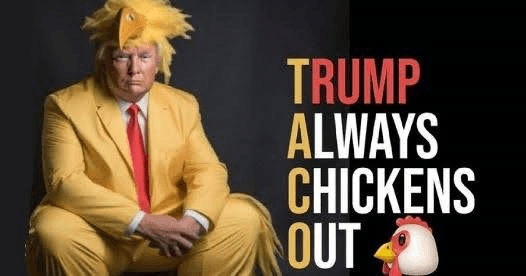
The term “TACO” (Trump Always Chickens Out) that was coined by Financial Times journalist Robert Armstrong describes what he says is the Source: Financial Express Source: Financial Express Source: Financial Express President’s pattern of announcing heavy tariffs, causing panic that hits stock markets and then later reversing course to create a market rebound. Recent key examples include tariff threats against China, the EU, and Canada, which were all either reduced, deferred, or restructured within days. This has led to a degree of scepticism among market participants, who now view any aggressive trade announcements as more noise than substance. While the TACO trade has so far rewarded investors, it now also introduces risk. Should Trump follow through on some of his heavier tariff threats, this pattern will break, and likely catch markets offside. For now, investors continue to embrace the TACO trade, which was the most profitable strategy over the quarter.
The term “TACO” (Trump Always Chickens Out) that was coined by Financial Times journalist Robert Armstrong describes what he says is the Source: Financial Express Source: Financial Express Source: Financial Express President’s pattern of announcing heavy tariffs, causing panic that hits stock markets and then later reversing course to create a market rebound. Recent key examples include tariff threats against China, the EU, and Canada, which were all either reduced, deferred, or restructured within days. This has led to a degree of scepticism among market participants, who now view any aggressive trade announcements as more noise than substance. While the TACO trade has so far rewarded investors, it now also introduces risk. Should Trump follow through on some of his heavier tariff threats, this pattern will break, and likely catch markets offside. For now, investors continue to embrace the TACO trade, which was the most profitable strategy over the quarter.
One Big Beautiful Bill
One Big
Beautiful Bill
One campaign promise Trump has followed through on is his “One Big Beautiful Bill” which has now passed through Congress.
One campaign promise Trump has followed through on is his “One Big Beautiful Bill” which has now passed through Congress.
This sweeping legislative package makes the tax cuts from Trump’s first term permanent, slashes taxes on tips and overtime, increases spending on border security, and introduces new tax breaks that primarily benefit higher earners. At the same time, it includes significant cuts to Medicaid, which will likely leave millions of vulnerable Americans without health insurance, while it also rolls back most of the green initiatives introduced under the Biden administration.
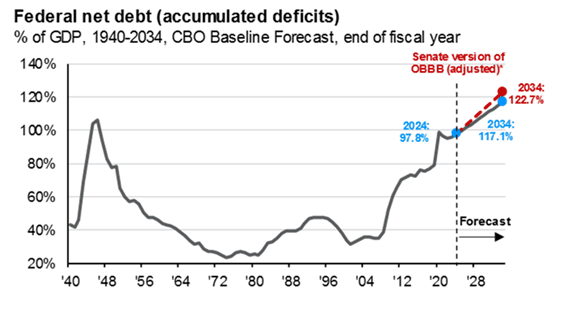
The majority of gains from the bill will accrue to wealthier households, while lower-income groups are expected to bear the burden, which is reflected in the bill’s low levels of public support. Tariff revenues will fall far short of covering the resulting fiscal gap, leading to increased debt issuance. Federal debt is projected to rise from 117% to 123% of GDP. Even though Trump began his second term with promises to reduce the deficit, the nonpartisan Congressional Budget Office (CBO) estimates this bill will add $3.3 trillion to U.S. debt by 2034 and offer little economic benefit.
This sweeping legislative package makes the tax cuts from Trump’s first term permanent, slashes taxes on tips and overtime, increases spending on border security, and introduces new tax breaks that primarily benefit higher earners. At the same time, it includes significant cuts to Medicaid, which will likely leave millions of vulnerable Americans without health insurance, while it also rolls back most of the green initiatives introduced under the Biden administration.
The majority of gains from the bill will accrue to wealthier households, while lower-income groups are expected to bear the burden, which is reflected in the bill’s low levels of public support. Tariff revenues will fall far short of covering the resulting fiscal gap, leading to increased debt issuance. Federal debt is projected to rise from 117% to 123% of GDP. Even though Trump began his second term with promises to reduce the deficit, the nonpartisan Congressional Budget Office (CBO) estimates this bill will add $3.3 trillion to U.S. debt by 2034 and offer little economic benefit.
A lot of fuss was made about the DOGE department spending cuts, but they are now expected to save about $150 billion a year, which is far less than the $2 trillion originally promised. The 'Big Beautiful Bill' triggered a very public fallout between Trump and Elon Musk, who publicly denounced the tax package as 'a disgusting abomination' and floated the idea of launching his own rival 'America Party.' Trump dismissed the idea as 'ridiculous' and even hinted at the possibility of deporting Musk.
A lot of fuss was made about the DOGE department spending cuts, but they are now expected to save about $150 billion a year, which is far less than the $2 trillion originally promised. The 'Big Beautiful Bill' triggered a very public fallout between Trump and Elon Musk, who publicly denounced the tax package as 'a disgusting abomination' and floated the idea of launching his own rival 'America Party.' Trump dismissed the idea as 'ridiculous' and even hinted at the possibility of deporting Musk.
The level of fiscal irresponsibility is putting upward pressure on U.S. bond yields, with the 30-year yield now hovering around 5%. While rising bond yields are a global phenomenon, the U.S. clearly stands out as being on an unsustainable fiscal trajectory. Trump’s motivation to pressure Fed Chair Jerome Powell into cutting their policy rate is clear, but the outlook for inflation still remains uncertain, given the risks posed by the new tariffs. The case for a higher allocation to real assets instead of the full traditional weighting to bonds is starting to make sense, as real assets also have inflation hedging characteristics. The outlook for European infrastructure and real estate is becoming particularly interesting.
The level of fiscal irresponsibility is putting upward pressure on U.S. bond yields, with the 30-year yield now hovering around 5%. While rising bond yields are a global phenomenon, the U.S. clearly stands out as being on an unsustainable fiscal trajectory. Trump’s motivation to pressure Fed Chair Jerome Powell into cutting their policy rate is clear, but the outlook for inflation still remains uncertain, given the risks posed by the new tariffs. The case for a higher allocation to real assets instead of the full traditional weighting to bonds is starting to make sense, as real assets also have inflation hedging characteristics. The outlook for European infrastructure and real estate is becoming particularly interesting.
Meanwhile, the S&P 500 has been notching new all-time highs (in dollar terms), with momentum stocks continually climbing higher. Nvidia, the poster child for AI momentum trades, shrugged off recent concerns over DeepSeek and tariffs to reclaim its position as the world’s largest company, becoming the first ever to reach a $4 trillion market cap. Yet, there is still evidence that global investors have been pulling back from U.S. assets, as evidenced by a continually weaker U.S. dollar.
Meanwhile, the S&P 500 has been notching new all-time highs (in dollar terms), with momentum stocks continually climbing higher. Nvidia, the poster child for AI momentum trades, shrugged off recent concerns over DeepSeek and tariffs to reclaim its position as the world’s largest company, becoming the first ever to reach a $4 trillion market cap. Yet, there is still evidence that global investors have been pulling back from U.S. assets, as evidenced by a continually weaker U.S. dollar.
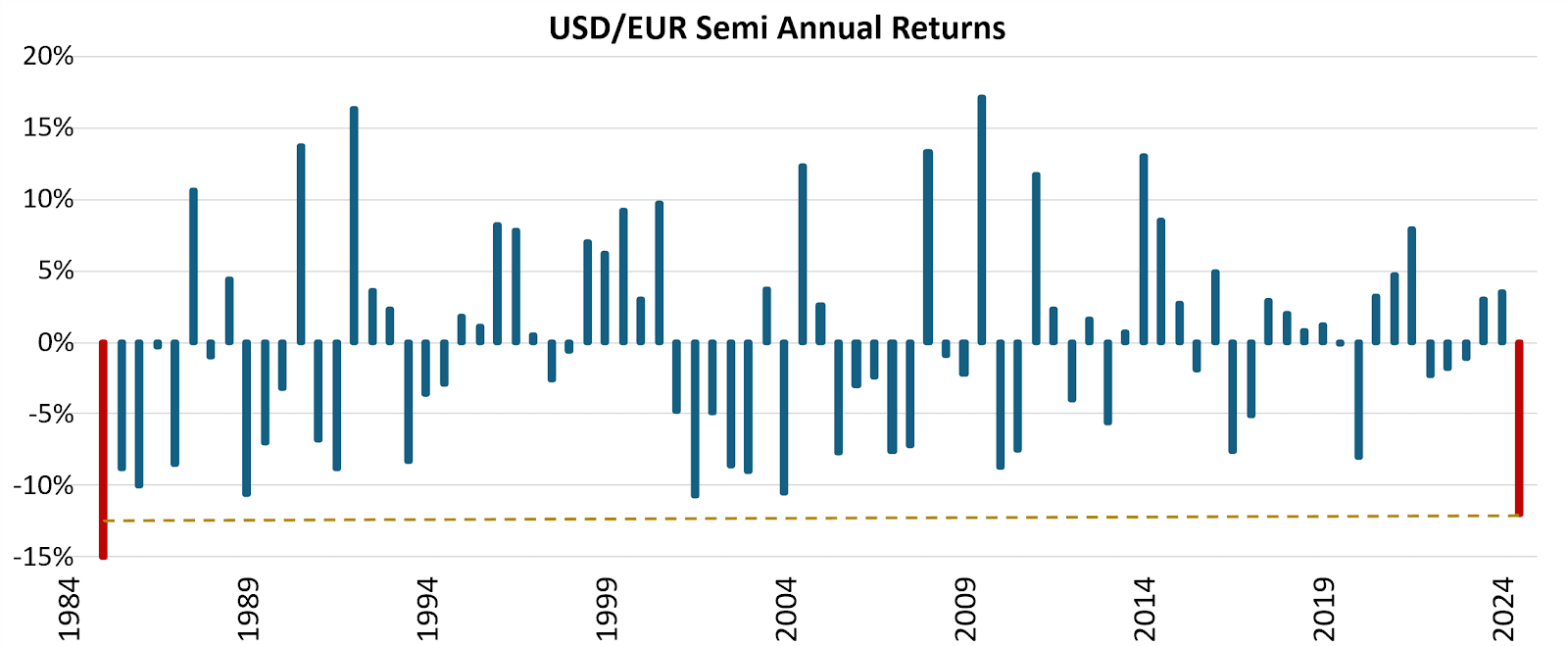
The worlds reserve currency just recorded its worst semi-annual performance in 40 years, and its worst start to a year on record. A weaker dollar means the headline US equity index still hasn’t recorded a new all-time high in euro terms, which is an obvious drag for Irish investors.
The worlds reserve currency just recorded its worst semi-annual performance in 40 years, and its worst start to a year on record. A weaker dollar means the headline US equity index still hasn’t recorded a new all-time high in euro terms, which is an obvious drag for Irish investors.
Slowing Growth, but no Recession
Slowing Growth, but no Recession
Looking ahead, the global economic picture is becoming more difficult.
Looking ahead, the global economic picture is becoming more difficult.
The World Bank recently lowered its growth forecast for 2025 to just 2.3% (the slowest pace in 17 years), while pointing to growing trade tensions and increasingly unpredictable government policies. Core U.S. economic data remains resilient, with the unemployment rate at 4.1% and a healthy number of jobs being added monthly, but forward looking business and consumer surveys still suggest a potential slowdown.
President Trump’s second term has brought greater political division, increased national debt, and a continued erosion of democratic norms. Despite this, stock markets have held up, largely thanks to continued strength from the large tech companies and a strong investor sentiment. But risks are quietly building, as U.S. stocks are once again trading over 22 times earnings (about 30% above their long-term average), which leaves little room for error. Meanwhile, the new tariffs are still expected to raise costs for American businesses and consumers at some point.
President Trump’s second term has brought greater political division, increased national debt, and a continued erosion of democratic norms. Despite this, stock markets have held up, largely thanks to continued strength from the large tech companies and a strong investor sentiment. But risks are quietly building, as U.S. stocks are once again trading over 22 times earnings (about 30% above their long-term average), which leaves little room for error. Meanwhile, the new tariffs are still expected to raise costs for American businesses and consumers at some point.
When we wrote our Q1 report on April 4th, it followed one of the sharpest two-day selloffs in market history. At the time, we referenced Morgan Housel’s quote that “Every past market decline looks like an opportunity; every future decline looks like a risk”. Just a few days later, on April 8th, President Trump reversed course on his tariffs, sparking a dramatic market rebound. We certainly won’t claim to have any great insight into President Trump’s seemingly chaotic thought process, but the volatility in April now already looks like another past buying opportunity. The faster than expected rebound once again highlights how emotional decisions made during market dips often hurts long-term investment results.
The World Bank recently lowered its growth forecast for 2025 to just 2.3% (the slowest pace in 17 years), while pointing to growing trade tensions and increasingly unpredictable government policies. Core U.S. economic data remains resilient, with the unemployment rate at 4.1% and a healthy number of jobs being added monthly, but forward looking business and consumer surveys still suggest a potential slowdown.
President Trump’s second term has brought greater political division, increased national debt, and a continued erosion of democratic norms. Despite this, stock markets have held up, largely thanks to continued strength from the large tech companies and a strong investor sentiment. But risks are quietly building, as U.S. stocks are once again trading over 22 times earnings (about 30% above their long-term average), which leaves little room for error. Meanwhile, the new tariffs are still expected to raise costs for American businesses and consumers at some point.
President Trump’s second term has brought greater political division, increased national debt, and a continued erosion of democratic norms. Despite this, stock markets have held up, largely thanks to continued strength from the large tech companies and a strong investor sentiment. But risks are quietly building, as U.S. stocks are once again trading over 22 times earnings (about 30% above their long-term average), which leaves little room for error. Meanwhile, the new tariffs are still expected to raise costs for American businesses and consumers at some point.
When we wrote our Q1 report on April 4th, it followed one of the sharpest two-day selloffs in market history. At the time, we referenced Morgan Housel’s quote that “Every past market decline looks like an opportunity; every future decline looks like a risk”. Just a few days later, on April 8th, President Trump reversed course on his tariffs, sparking a dramatic market rebound. We certainly won’t claim to have any great insight into President Trump’s seemingly chaotic thought process, but the volatility in April now already looks like another past buying opportunity. The faster than expected rebound once again highlights how emotional decisions made during market dips often hurts long-term investment results.
Ciaran Carolan 11/07/2025
Ciaran Carolan 11/07/2025

At DFP, we offer financial management advice to individuals, charities, corporate partnerships and businesses, which is specifically designed around their individual circumstances.
Docal Ltd. t/a DFP Pension & Investment Consultants is regulated by the Central Bank of Ireland.
Registered Address: 1st Floor Quayside Business Park,
Mill Street, Dundalk, Co. Louth. Registered in Ireland, company registration number 390947
At DFP, we offer financial management advice to individuals, charities, corporate partnerships and businesses, which is specifically designed around their individual circumstances.
Docal Ltd. t/a DFP Pension & Investment Consultants is regulated by the Central Bank of Ireland.
Registered Address: 1st Floor Quayside Business Park,
Mill Street, Dundalk, Co. Louth. Registered in Ireland, company registration number 390947
At DFP, we offer financial management advice to individuals, charities, corporate partnerships and businesses, which is specifically designed around their individual circumstances.
Docal Ltd. t/a DFP Pension & Investment Consultants is regulated by the Central Bank of Ireland.
Registered Address: 1st Floor Quayside Business Park,
Mill Street, Dundalk, Co. Louth. Registered in Ireland, company registration number 390947