
Estimated read time: 7 mins
Q1 Quarterly Report 2025
Turbulent Times
Turbulent Times
"There are decades when nothing happens, and weeks when decades happen"
"There are decades when nothing happens, and weeks when decades happen"
This is the phrase that comes to mind when looking back over the first quarter of 2025. This was a remarkably eventful period for world affairs and investment markets, as the newly elected US president, Donald Trump has signed over 100 executive orders since taking office just over seventy days ago. As part of his actions, Trump has already slashed the federal workforce, enforced a “two sexes” recognition, cut USAID, and upended US foreign policy. He has also claimed he wants to annex Canada, Greenland, and the Panama Canal, whilst taking a hardline pro-Israel stance.
Keeping up to date with the flurry of orders has been challenging and some of his posts on his Truth platform have been quite disturbing. From an economic and markets perspective, tariffs have been the point of focus, as Trump started trade wars with Canada and Mexico, renewed the ongoing trade war with China and then started to put a lot of focus on April 2nd.
This is the phrase that comes to mind when looking back over the first quarter of 2025. This was a remarkably eventful period for world affairs and investment markets, as the newly elected US president, Donald Trump has signed over 100 executive orders since taking office just over seventy days ago. As part of his actions, Trump has already slashed the federal workforce, enforced a “two sexes” recognition, cut USAID, and upended US foreign policy. He has also claimed he wants to annex Canada, Greenland, and the Panama Canal, whilst taking a hardline pro-Israel stance.
Keeping up to date with the flurry of orders has been challenging and some of his posts on his Truth platform have been quite disturbing. From an economic and markets perspective, tariffs have been the point of focus, as Trump started trade wars with Canada and Mexico, renewed the ongoing trade war with China and then started to put a lot of focus on April 2nd.
Mar
Feb
Jan
Q1
2024
Equities
MSCI World
-4.5%
-0.7%
3.5%
-1.8%
18.7%
S&P 500
-5.7%
-1.3%
2.8%
-4.4%
24.5%
EURO STOXX
-2.9%
3.5%
7.3%
7.8%
10.1%
Nikkei 225
-3.5%
-6.1%
-0.8%
-10.1%
20.9%
MSCI UK
-1.8%
2.2%
6.1%
6.4%
9.5%
MSCI EM
0.6%
0.5%
1.8%
2.9%
7.5%
MSCI China
1.5%
12.1%
0.4%
14.3%
22.9%
Government Bonds
US Treasuries
0.2%
2.2%
0.5%
2.9%
0.7%
EUR Sovereigns
-1.8%
0.7%
-0.2%
-1.3%
1.9%
Corporate Bonds
US High Grade
-0.3%
2.0%
0.6%
2.4%
2.8%
EUR High Grade
-0.9%
0.6%
0.5%
0.2%
4.7%
Commodities
Commodity Index
2.9%
-1.3%
3.3%
4.9%
9.3%
Oil (Crude)
2.9%
-3.5%
2.4%
1.7%
8.7%
Copper
4.0%
4.0%
3.1%
11.5%
1.9%
Gold
9.9%
0.8%
6.7%
18.2%
26.6%
Currencies
EUR/USD
3.9%
0.0%
0.4%
4.3%
-6.3%
EUR/GBP
1.3%
-1.3%
1.2%
1.2%
-4.6%
EUR/JPY
3.1%
-2.6%
-1.1%
-0.7%
4.5%
Mar
Feb
Jan
Q1
2024
MSCI World
-4.5%
-0.7%
3.5%
-1.8%
18.7%
S&P 500
-5.7%
-1.3%
2.8%
-4.4%
24.5%
EURO STOXX
-2.9%
3.5%
7.3%
7.8%
10.1%
Nikkei 225
-3.5%
-6.1%
-0.8%
-10.1%
20.9%
MSCI UK
-1.8%
2.2%
6.1%
6.4%
9.5%
MSCI EM
0.6%
0.5%
1.8%
2.9%
7.5%
MSCI China
1.5%
12.1%
0.4%
14.3%
22.9%
Equities
This was to be his ”Liberation Day” where he would announce a definitive set of global tariffs. The Rose Garden event was delivered in the usual theatrical fashion we have come to expect, but the level of tariffs went far beyond the market’s expectations. If implemented, they will have a big impact on global growth and inflation, but first we quickly recap on an eventful first quarter before this announcement.
This was to be his ”Liberation Day” where he would announce a definitive set of global tariffs. The Rose Garden event was delivered in the usual theatrical fashion we have come to expect, but the level of tariffs went far beyond the market’s expectations. If implemented, they will have a big impact on global growth and inflation, but first we quickly recap on an eventful first quarter before this announcement.
It's Been a Rollercoster of a Year So Far
Trump Pump Turns into a Slump
Trump Pump Turns into a Slump
It feels like a long time ago, but the S&P 500 started the year very brightly, having climbed nearly 5% to reach an all-time high on February 19th.
It feels like a long time ago, but the S&P 500 started the year very brightly, having climbed nearly 5% to reach an all-time high on February 19th.
Equities entered the year with strong momentum after the US election results, as the market was happy to focus on the positive aspects from Trump’s campaign – lower taxes and de-regulation. Sentiment began to turn negative in February when it became clear that the new administration was prioritising the more challenging policies first, as immigration (likely to cause inflationary pressures) and tariffs (likely to cause both inflation and lower growth) began to dominate headlines and these potential policy changes could have a negative lasting impact on the global economy.
The S&P 500 ended the quarter down 4.7% in dollar terms, but this weakness was further compounded for Irish investors as the dollar also gave up 4% against the euro. This type of dollar weakness during a risk-off period was unusual from a historical context, as it is usually a safe haven. The so- called Mag 7 tech stocks morphed into the Lag 7, as they entered a bear market and Bitcoin also struggled even though Gold had its best quarter since the 1980’s. Tesla was also down over 30% in what was another example of the post-election momentum trades being completely upended.
Equities entered the year with strong momentum after the US election results, as the market was happy to focus on the positive aspects from Trump’s campaign – lower taxes and de-regulation. Sentiment began to turn negative in February when it became clear that the new administration was prioritising the more challenging policies first, as immigration (likely to cause inflationary pressures) and tariffs (likely to cause both inflation and lower growth) began to dominate headlines and these potential policy changes could have a negative lasting impact on the global economy.
The S&P 500 ended the quarter down 4.7% in dollar terms, but this weakness was further compounded for Irish investors as the dollar also gave up 4% against the euro. This type of dollar weakness during a risk-off period was unusual from a historical context, as it is usually a safe haven. The so- called Mag 7 tech stocks morphed into the Lag 7, as they entered a bear market and Bitcoin also struggled even though Gold had its best quarter since the 1980’s. Tesla was also down over 30% in what was another example of the post-election momentum trades being completely upended.
Some of the US tech sector pain can also be attributed to the low-cost Chinese AI model DeepSeek that reached the top of the download charts earlier in the year. This new app raised big concerns about the level of AI capex spending from the Mag 7 to date, as DeepSeek claims a very high level of accuracy, even though it operates with far less energy requirements and was built at a fraction of the cost. This exciting new development boosted Chinese tech stocks while US tech was getting punished, as Alibaba rose nearly 60% to lift its volatile sector to one of the top performing global sectors for Q1.
Some of the US tech sector pain can also be attributed to the low-cost Chinese AI model DeepSeek that reached the top of the download charts earlier in the year. This new app raised big concerns about the level of AI capex spending from the Mag 7 to date, as DeepSeek claims a very high level of accuracy, even though it operates with far less energy requirements and was built at a fraction of the cost. This exciting new development boosted Chinese tech stocks while US tech was getting punished, as Alibaba rose nearly 60% to lift its volatile sector to one of the top performing global sectors for Q1.
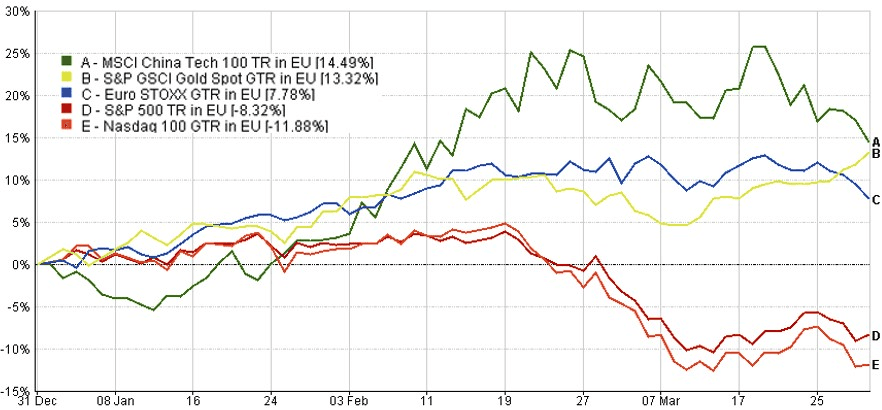
This move was supported by low initial valuations from the depressed sentiment toward the region. European equities were another top regional performer, as the regions headline index outperformed its US counterpart by the most in over three decades. A speech by US Vice President JD Vance to the Munich security conference in February was a topic of much debate, as it showed the trans-Atlantic defense alliance was effectively over “The threat that I worry the most about vis-à-vis Europe is not Russia…What I worry about is…the retreat of Europe from some of its most fundamental values, values shared with the United States”.
This move was supported by low initial valuations from the depressed sentiment toward the region. European equities were another top regional performer, as the regions headline index outperformed its US counterpart by the most in over three decades. A speech by US Vice President JD Vance to the Munich security conference in February was a topic of much debate, as it showed the trans-Atlantic defense alliance was effectively over “The threat that I worry the most about vis-à-vis Europe is not Russia…What I worry about is…the retreat of Europe from some of its most fundamental values, values shared with the United States”.
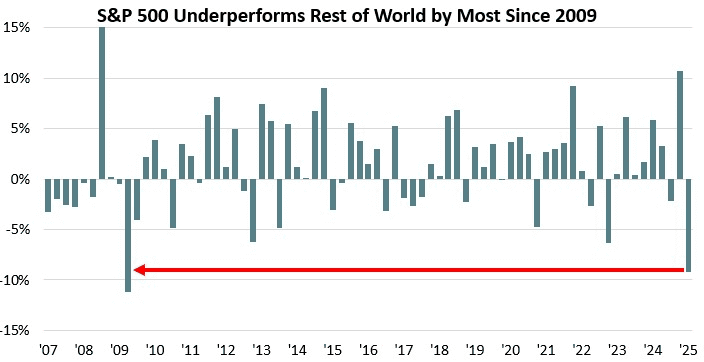
European countries had been trimming defense expenditure, so there was a point, but the tone was clearly quite challenging. But Europe tends to do best in time of crisis, and this actually helped galvanise policymakers into action that eventually led to the new German chancellor Friedrich Merz announcing record levels of fiscal stimulus for defense and infrastructure. Germany finally recognises the need to spend to achieve growth, and with the foot being taken off Europe’s fiscal and monetary brake, equities re-rated from a low base. Record flows of capital moved to the region at a time the US outlook had started to become materially weaker.
European countries had been trimming defense expenditure, so there was a point, but the tone was clearly quite challenging. But Europe tends to do best in time of crisis, and this actually helped galvanise policymakers into action that eventually led to the new German chancellor Friedrich Merz announcing record levels of fiscal stimulus for defense and infrastructure. Germany finally recognises the need to spend to achieve growth, and with the foot being taken off Europe’s fiscal and monetary brake, equities re-rated from a low base. Record flows of capital moved to the region at a time the US outlook had started to become materially weaker.
Trump's Tariffs
“Liberation Day”
After a lot of debate as to whether we would see blanket or reciprocal tariffs, President Trump included both when he announced the highest tariffs in a century last Wednesday.
After a lot of debate as to whether we would see blanket or reciprocal tariffs, President Trump included both when he announced the highest tariffs in a century last Wednesday.
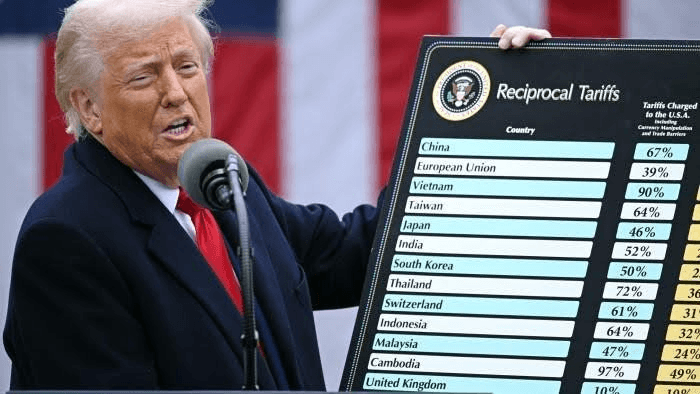
This included tariffs of 54% on China, 20% on the EU, 24% on Japan, and 26% on India, while other Asian countries like Vietnam and Thailand stand to be the worst affected. The game show type chart that was proudly paraded included new tariff rates for about 50 countries, and any country not on the board would be subject to a blanket 10%. Mexico and Canada avoid more new tariffs for now, but the initial market reaction has understandably been very negative, as the aggregate levels were much higher than any of the top prior estimates. Notably, the UK was given the lower 10% rate, which would finally represent a Brexit benefit.
This included tariffs of 54% on China, 20% on the EU, 24% on Japan, and 26% on India, while other Asian countries like Vietnam and Thailand stand to be the worst affected. The game show type chart that was proudly paraded included new tariff rates for about 50 countries, and any country not on the board would be subject to a blanket 10%. Mexico and Canada avoid more new tariffs for now, but the initial market reaction has understandably been very negative, as the aggregate levels were much higher than any of the top prior estimates. Notably, the UK was given the lower 10% rate, which would finally represent a Brexit benefit.
So, are the tariffs here to stay?
It is still unclear whether they are an attempt to gain trading concessions, or whether they are focussed on achieving long term structural changes that would bring manufacturing back to the US (Rust Belt). The latter will be more problematic as it would mean a prolonged tit for tat trading war with the other main global regions. Longer-term tariffs would imply the administration is trying to roll back globalization in a way that the US can escape its greatest downsides (inequality and a struggling working class), while not sacrificing upsides (low inflation, low rates, and strong asset prices). Secretary of State Scott Bessent immediately referenced the potential negotiations for concessions after the announcement, while Trump himself has said he is open to “phenomenal offers”.
Overall, we hope there will be some form of negotiations that can bring these absurd levels down, but the initial response from some other countries has been firm. Mark Carney’s hard-line stance looks set to win him this month’s Canadian election, while Frech President Macron’s has called for European companies to suspend their planned investment in the US. Ireland would be particularly exposed to a tit for tat trade European trade war, as US services would be a likely target, which our tax revenue is heavily dependant on.
So, are the tariffs here to stay?
It is still unclear whether they are an attempt to gain trading concessions, or whether they are focussed on achieving long term structural changes that would bring manufacturing back to the US (Rust Belt). The latter will be more problematic as it would mean a prolonged tit for tat trading war with the other main global regions. Longer-term tariffs would imply the administration is trying to roll back globalization in a way that the US can escape its greatest downsides (inequality and a struggling working class), while not sacrificing upsides (low inflation, low rates, and strong asset prices). Secretary of State Scott Bessent immediately referenced the potential negotiations for concessions after the announcement, while Trump himself has said he is open to “phenomenal offers”.
Overall, we hope there will be some form of negotiations that can bring these absurd levels down, but the initial response from some other countries has been firm. Mark Carney’s hard-line stance looks set to win him this month’s Canadian election, while Frech President Macron’s has called for European companies to suspend their planned investment in the US. Ireland would be particularly exposed to a tit for tat trade European trade war, as US services would be a likely target, which our tax revenue is heavily dependant on.
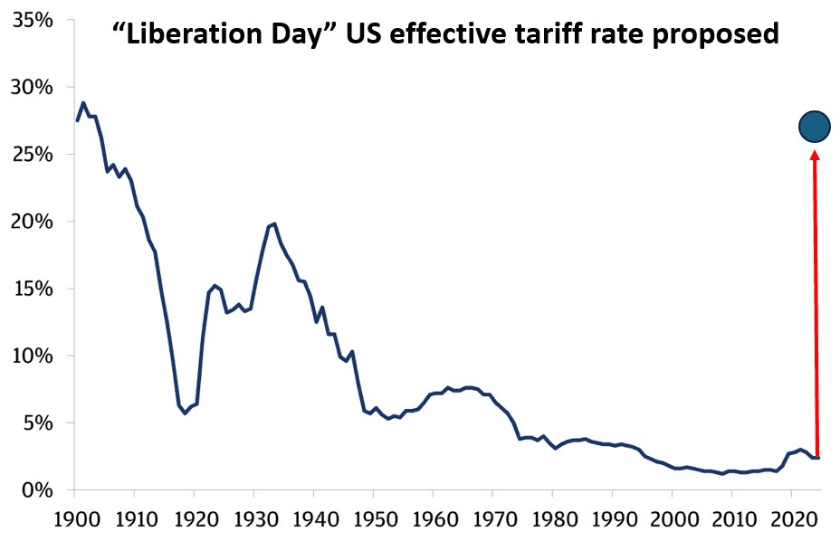
Although the new US administration had claimed they would conduct in-depth assessments of their trade relationships, that clearly didn’t happen. The US trade representative’s office released the formula that was used to calculate the tariffs currently being “charged” to the US. This document showed how they simply divided a country’s net exports to the US (exports minus imports) by its exports to the US. It seems as though the higher the ratio, the more protectionist the country must be, which is elementary on many levels, but these inflated figures helped the President’s narrative of the US being “raped and pillaged” by its trading partners.
Although the new US administration had claimed they would conduct in-depth assessments of their trade relationships, that clearly didn’t happen. The US trade representative’s office released the formula that was used to calculate the tariffs currently being “charged” to the US. This document showed how they simply divided a country’s net exports to the US (exports minus imports) by its exports to the US. It seems as though the higher the ratio, the more protectionist the country must be, which is elementary on many levels, but these inflated figures helped the President’s narrative of the US being “raped and pillaged” by its trading partners.
Admittedly, there is a discrepancy between the US sales tax on imports versus the EU VAT rate for example, but the formula that was used basically punishes regions with a big surplus in goods trade and completely ignores the big services surplus the US typically enjoys. If tariffs are to stay in play longer term, the new administration will want them to boost public finances through increased domestic manufacturing.
They hope this would lead to better overall economic growth that would allow them to cut taxes and improve overall wealth that would then drive further demand. This is a highly ambitious plan, and the market clearly doesn’t think it can be achieved. For now, the only thing they are likely to achieve is a real income shock for its own consumers. Is Trump really prepared to go through a prolonged period of transitional pain, or this just a transactional tool for extracting concessions from trade partners? Whether countries retaliate or try to de-escalate the situation will be huge in determining whether the highest proposed tariff levels in over a century remain in play.
Admittedly, there is a discrepancy between the US sales tax on imports versus the EU VAT rate for example, but the formula that was used basically punishes regions with a big surplus in goods trade and completely ignores the big services surplus the US typically enjoys. If tariffs are to stay in play longer term, the new administration will want them to boost public finances through increased domestic manufacturing.
They hope this would lead to better overall economic growth that would allow them to cut taxes and improve overall wealth that would then drive further demand. This is a highly ambitious plan, and the market clearly doesn’t think it can be achieved. For now, the only thing they are likely to achieve is a real income shock for its own consumers. Is Trump really prepared to go through a prolonged period of transitional pain, or this just a transactional tool for extracting concessions from trade partners? Whether countries retaliate or try to de-escalate the situation will be huge in determining whether the highest proposed tariff levels in over a century remain in play.
As things stand
Current economic data still points to a strong US economy, as real GDP grew at 2.4% in the fourth quarter of 2024, February’s CPI was 2.8% and the unemployment rate for March was 4.2%.
Current economic data still points to a strong US economy, as real GDP grew at 2.4% in the fourth quarter of 2024, February’s CPI was 2.8% and the unemployment rate for March was 4.2%.
The US jobs data for March that was just released last Friday, also contained a big upside surprise in the number of jobs added (228k versus the 117k prior estimate). Forward looking sentiment data (soft data) from businesses and consumers has however turned materially weaker, as there are understandable worries about where the economy is now heading. Subprime delinquencies had already been rising, and lower earnings guidance from upscale American home furnishing company RH last week suggests this weakness may not remain confined to the lower income cohort.
There have been several very volatile trading days since the tariffs were announced last week, because they have clearly increased the odds of a US and global recession. Q1 earnings season kicks off on Friday, and although analysts had already lowered their S&P 500 earnings growth estimates from 13% to 10%, companies could potentially remove any forward guidance because of the uncertainty these tariffs have brought. The market clearly wasn’t priced for these high tariff rates, because they don’t make sense on so many levels.
Focussing on the proposed tariffs on Vietnam and the impact it would have on Nike highlights some the obvious concerns. Vietnam has a 5% tariff rate on US goods, but will Vietnamese citizens be able to afford more US goods if this is removed? Do US citizens really want to work in these labour-intensive factories in the US? The proposed moves would simply result in lower profits for Nike, higher prices for US consumers and lower economic growth for both the US and Vietnam. The longer the new administration’s antics continue, the more likely the weaker leading confidence indicators will translate into weaker hard economic data.
Although periods of elevated market volatility can be uncomfortable, our advice remains to stay invested. Historical data highlights the difficulty of timing the market, with 78% of the stock market’s best days occurring during bear markets or within the first two months of a bull market. Missing these key days can significantly impact long-term returns. Our decision to adopt a more defensive position earlier in the year was the right moment to act. Now, with such wild swings taking place, it’s important to stick with the strategy already in place. It’s worth remembering that markets now offer better value than they did at the start of the year due to recent movements. While future potential selloffs look like risks, past selloffs always look like opportunities.
The US jobs data for March that was just released last Friday, also contained a big upside surprise in the number of jobs added (228k versus the 117k prior estimate). Forward looking sentiment data (soft data) from businesses and consumers has however turned materially weaker, as there are understandable worries about where the economy is now heading. Subprime delinquencies had already been rising, and lower earnings guidance from upscale American home furnishing company RH last week suggests this weakness may not remain confined to the lower income cohort.
There have been several very volatile trading days since the tariffs were announced last week, because they have clearly increased the odds of a US and global recession. Q1 earnings season kicks off on Friday, and although analysts had already lowered their S&P 500 earnings growth estimates from 13% to 10%, companies could potentially remove any forward guidance because of the uncertainty these tariffs have brought. The market clearly wasn’t priced for these high tariff rates, because they don’t make sense on so many levels.
Focussing on the proposed tariffs on Vietnam and the impact it would have on Nike highlights some the obvious concerns. Vietnam has a 5% tariff rate on US goods, but will Vietnamese citizens be able to afford more US goods if this is removed? Do US citizens really want to work in these labour-intensive factories in the US? The proposed moves would simply result in lower profits for Nike, higher prices for US consumers and lower economic growth for both the US and Vietnam. The longer the new administration’s antics continue, the more likely the weaker leading confidence indicators will translate into weaker hard economic data.
Although periods of elevated market volatility can be uncomfortable, our advice remains to stay invested. Historical data highlights the difficulty of timing the market, with 78% of the stock market’s best days occurring during bear markets or within the first two months of a bull market. Missing these key days can significantly impact long-term returns. Our decision to adopt a more defensive position earlier in the year was the right moment to act. Now, with such wild swings taking place, it’s important to stick with the strategy already in place. It’s worth remembering that markets now offer better value than they did at the start of the year due to recent movements. While future potential selloffs look like risks, past selloffs always look like opportunities.
Ciaran Carolan 11/04/2025
Ciaran Carolan 11/04/2025

At DFP, we offer financial management advice to individuals, charities, corporate partnerships and businesses, which is specifically designed around their individual circumstances.
Docal Ltd. t/a DFP Pension & Investment Consultants is regulated by the Central Bank of Ireland.
Registered Address: 1st Floor Quayside Business Park,
Mill Street, Dundalk, Co. Louth. Registered in Ireland, company registration number 390947
At DFP, we offer financial management advice to individuals, charities, corporate partnerships and businesses, which is specifically designed around their individual circumstances.
Docal Ltd. t/a DFP Pension & Investment Consultants is regulated by the Central Bank of Ireland.
Registered Address: 1st Floor Quayside Business Park,
Mill Street, Dundalk, Co. Louth. Registered in Ireland, company registration number 390947
At DFP, we offer financial management advice to individuals, charities, corporate partnerships and businesses, which is specifically designed around their individual circumstances.
Docal Ltd. t/a DFP Pension & Investment Consultants is regulated by the Central Bank of Ireland.
Registered Address: 1st Floor Quayside Business Park,
Mill Street, Dundalk, Co. Louth. Registered in Ireland, company registration number 390947