
Estimated read time: 5 mins
Q1 Quarterly Report 2026
Back To Basics
Back To Basics
When assessing investment assets, investors weigh a wide range of variables including economic growth, inflation, interest rates, employment, currency movements, geopolitical risk, liquidity conditions, and corporate earnings expectations, to name but a few. The objective is simply to determine whether an asset is cheap or expensive relative to what it deserves to be worth, with the complication being that every other buyer and seller in the market is conducting the same exercise.
When assessing investment assets, investors weigh a wide range of variables including economic growth, inflation, interest rates, employment, currency movements, geopolitical risk, liquidity conditions, and corporate earnings expectations, to name but a few. The objective is simply to determine whether an asset is cheap or expensive relative to what it deserves to be worth, with the complication being that every other buyer and seller in the market is conducting the same exercise.
For equity investors, corporate earnings are the key variable. Investors will rationally pay more for companies generating strong earnings, and more again where those earnings are expected to grow. The logic is sound, but in practice, the price is determined by supply and demand, and demand does not always follow logic. Tesla is a useful example, as the stock currently trades at over 190 times next year's expected earnings despite earnings growth having stalled and early expectations of EV market dominance having proven overly ambitious. A rational investor might short the stock, and many have tried. The problem is that sustained retail demand has kept the valuation elevated far longer than fundamentals would justify, and being right too early in markets can be just as costly as being wrong.
For equity investors, corporate earnings are the key variable. Investors will rationally pay more for companies generating strong earnings, and more again where those earnings are expected to grow. The logic is sound, but in practice, the price is determined by supply and demand, and demand does not always follow logic. Tesla is a useful example, as the stock currently trades at over 190 times next year's expected earnings despite earnings growth having stalled and early expectations of EV market dominance having proven overly ambitious. A rational investor might short the stock, and many have tried. The problem is that sustained retail demand has kept the valuation elevated far longer than fundamentals would justify, and being right too early in markets can be just as costly as being wrong.
Mar
Feb
Jan
Q1
Equities
MSCI World
-6.4%
0.7%
2.2%
-3.6%
S&P 500
-5.0%
-0.8%
1.4%
-4.4%
EURO STOXX
-8.4%
3.5%
2.9%
-2.4%
Nikkei 225
-12.8%
10.4%
5.9%
2.0%
MSCI UK
-5.9%
7.3%
3.1%
4.1%
MSCI EM
-13.1%
5.5%
8.9%
-0.2%
MSCI China
-7.0%
-7.0%
4.1%
-10.0%
Government Bonds
US Treasuries
-1.7%
1.8%
-0.1%
0.0%
EUR Sovereigns
-2.7%
1.4%
0.7%
-0.6%
Corporate Bonds
US High Grade
-2.0%
1.3%
0.4%
-0.4%
EUR High Grade
-2.3%
0.6%
0.8%
-1.0%
Commodities
Commodity Index
24.5%
2.4%
9.8%
40.0%
Oil (Crude)
54.8%
3.1%
13.9%
81.7%
Copper
-7.6%
1.6%
5.7%
-0.7%
Gold
-11.2%
10.9%
8.8%
7.1%
Currencies
EUR/USD
-2.4%
-0.8%
1.3%
-1.9%
EUR/GBP
-0.5%
1.3%
-0.7%
0.1%
EUR/JPY
-0.6%
0.5%
-0.3%
-0.4%
May
Apr
Q2
YTD
MSCI World
-6.4%
0.7%
2.2%
-3.6%
S&P 500
-5.0%
-0.8%
1.4%
-4.4%
EURO STOXX
-8.4%
3.5%
2.9%
-2.4%
Nikkei 225
-12.8%
10.4%
5.9%
2.0%
MSCI UK
-5.9%
7.3%
3.1%
4.1%
MSCI EM
-13.1%
5.5%
8.9%
-0.2%
MSCI China
-7.0%
-7.0%
4.1%
-10.0%
Equities
Investors are always looking into the future, seeking stability and growth in earnings over time, which raises what should be the first question any investor asks: what is my investment time horizon? Investors might be concerned about the near-term direction of corporate earnings because of some obvious potential challenge, but should this really be a concern for someone who has done their homework and wants to invest in a company that is very likely to grow for decades to come? This is all very relevant today, as the conflict in the Middle East poses a real risk to the global energy supply.
Investors are always looking into the future, seeking stability and growth in earnings over time, which raises what should be the first question any investor asks: what is my investment time horizon? Investors might be concerned about the near-term direction of corporate earnings because of some obvious potential challenge, but should this really be a concern for someone who has done their homework and wants to invest in a company that is very likely to grow for decades to come? This is all very relevant today, as the conflict in the Middle East poses a real risk to the global energy supply.
Conflict in the Middle East
Conflict in the Middle East
Markets initially showed remarkable resilience to the conflict before selling off sharply, only to recover again on ceasefire hopes. The recovery reflects a belief that a resolution is coming, but the picture on the ground remains volatile. The Strait of Hormuz, the vital choke point for global energy, briefly reopened on 17th April before closing again within hours, which is typical of the chaotic news flow that has been difficult to follow. We feel two things needed to happen for a resolution: (i) The US to force Israel to stop bombing Lebanon and (ii) The US to concede to most Iranian demands.
Markets initially showed remarkable resilience to the conflict before selling off sharply, only to recover again on ceasefire hopes. The recovery reflects a belief that a resolution is coming, but the picture on the ground remains volatile. The Strait of Hormuz, the vital choke point for global energy, briefly reopened on 17th April before closing again within hours, which is typical of the chaotic news flow that has been difficult to follow. We feel two things needed to happen for a resolution: (i) The US to force Israel to stop bombing Lebanon and (ii) The US to concede to most Iranian demands.
There have been recent grounds for optimism on both points, though they rest on Trump Truth Social posts, which we admittedly usually aim to avoid. In one post Trump stated: "Israel will not be bombing Lebanon any longer. They are PROHIBITED from doing so by the U.S.A. Enough is enough!!!". A subsequent post was notably different from his usual tone, dropping the threats on power plants, and the regime change language in favour of a comparison with Obama's nuclear deal: "My deal will be far better". When someone starts explaining why their deal beats their predecessor's, a deal is usually coming. On the Iranian side, China's foreign ministry stated this week that force is not the solution and that armed conflict only breeds hatred.
There have been recent grounds for optimism on both points, though they rest on Trump Truth Social posts, which we admittedly usually aim to avoid. In one post Trump stated: "Israel will not be bombing Lebanon any longer. They are PROHIBITED from doing so by the U.S.A. Enough is enough!!!". A subsequent post was notably different from his usual tone, dropping the threats on power plants, and the regime change language in favour of a comparison with Obama's nuclear deal: "My deal will be far better". When someone starts explaining why their deal beats their predecessor's, a deal is usually coming. On the Iranian side, China's foreign ministry stated this week that force is not the solution and that armed conflict only breeds hatred.
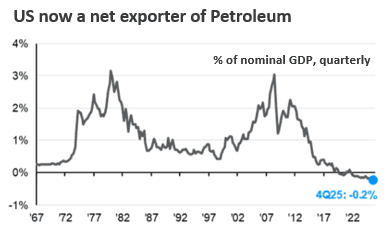
The obvious question is what happens to the economy and markets if the conflict continues? Middle Eastern oil and gas supply has been severely disrupted, with few historical parallels. While stockpiles have absorbed some of the impact, no reserves for refined products means jet fuel and diesel prices have risen well beyond the moves in crude markets. Petrochemical inputs for manufacturing and fertiliser supply are under similar pressure. A rapid resolution would not fully solve the problem, as some production capacity will be offline for years regardless of when the conflict ends.
The obvious question is what happens to the economy and markets if the conflict continues? Middle Eastern oil and gas supply has been severely disrupted, with few historical parallels. While stockpiles have absorbed some of the impact, no reserves for refined products means jet fuel and diesel prices have risen well beyond the moves in crude markets. Petrochemical inputs for manufacturing and fertiliser supply are under similar pressure. A rapid resolution would not fully solve the problem, as some production capacity will be offline for years regardless of when the conflict ends.
Emerging market governments have issued energy curtailment orders in response to outright shortages, and if the conflict drags on, Western governments may face similar decisions, with Europe being relatively more exposed. The US is better insulated given its energy independence, but gasoline prices have still surged, and consumers have largely exhausted the savings built up during Covid.
Emerging market governments have issued energy curtailment orders in response to outright shortages, and if the conflict drags on, Western governments may face similar decisions, with Europe being relatively more exposed. The US is better insulated given its energy independence, but gasoline prices have still surged, and consumers have largely exhausted the savings built up during Covid.
The Horizon That Matters
The Horizon That Matters
The Horizon That Matters
A continuation of the conflict will drive energy prices higher, leading to an inflation spike and lower corporate earnings. An inflation spike results in a loss of purchasing power that we never get back, whereas lower corporate earnings would likely lead to an equity market pullback of the kind that has always recovered. Humility is a desirable attribute as an investor, and no one can say with certainty how this unfolds in the days and weeks ahead. For us, the main consideration for our clients is each individual’s timeline. Clearly there are near-term cyclical risks, but longer-term investors should remember that investing in equities represents ownership in real businesses. Capitalism demands a return on capital and companies that fail to deliver one do not survive.
A continuation of the conflict will drive energy prices higher, leading to an inflation spike and lower corporate earnings. An inflation spike results in a loss of purchasing power that we never get back, whereas lower corporate earnings would likely lead to an equity market pullback of the kind that has always recovered. Humility is a desirable attribute as an investor, and no one can say with certainty how this unfolds in the days and weeks ahead. For us, the main consideration for our clients is each individual’s timeline. Clearly there are near-term cyclical risks, but longer-term investors should remember that investing in equities represents ownership in real businesses. Capitalism demands a return on capital and companies that fail to deliver one do not survive.
This dynamic drives equity returns over time, and investing in equities means participating in the long-term compounding of global capitalism. Equity markets reflect this, rising consistently over the long term as expanding economies drive higher corporate earnings. There are also several structural dynamics that increase long-term demand for equities and reduce potential prolonged selling pressure:
This dynamic drives equity returns over time, and investing in equities means participating in the long-term compounding of global capitalism. Equity markets reflect this, rising consistently over the long term as expanding economies drive higher corporate earnings. There are also several structural dynamics that increase long-term demand for equities and reduce potential prolonged selling pressure:
Share buybacks have been widespread and legally accepted since the 1980s, with S&P 500 companies repurchasing stock at scale and providing a persistent source of demand.
Share buybacks have been widespread and legally accepted since the 1980s, with S&P 500 companies repurchasing stock at scale and providing a persistent source of demand.
The shift from defined benefit to defined contribution pension schemes has redirected retirement savings into equity markets, creating another persistent flow of demand.
The shift from defined benefit to defined contribution pension schemes has redirected retirement savings into equity markets, creating another persistent flow of demand.
Regulatory changes and the growth of private markets have reduced the number of publicly listed companies, concentrating investor demand across a shrinking opportunity set.
Regulatory changes and the growth of private markets have reduced the number of publicly listed companies, concentrating investor demand across a shrinking opportunity set.
US tax rules create a strong incentive for long-term investors to hold until death when tax liabilities are erased, which keeps long-term holders in the market.
US tax rules create a strong incentive for long-term investors to hold until death when tax liabilities are erased, which keeps long-term holders in the market.
Higher-income households save and invest, while lower- income households consume. Rising inequality has increased the pool of capital being allocated to financial assets.
Higher-income households save and invest, while lower- income households consume. Rising inequality has increased the pool of capital being allocated to financial assets.
Together, these forces create a system biased toward buying equities and holding them, regardless of what might happen. Despite the inevitability of future recessions, wars, and other events that will drive markets lower, long-term investors will be rewarded for their temperament and patience. For those with shorter-term goals, a degree of caution is understandable. Markets are priced for a near-term resolution, but the crisis may not yet have peaked, nor its impact on the economy and markets.
Together, these forces create a system biased toward buying equities and holding them, regardless of what might happen. Despite the inevitability of future recessions, wars, and other events that will drive markets lower, long-term investors will be rewarded for their temperament and patience. For those with shorter-term goals, a degree of caution is understandable. Markets are priced for a near-term resolution, but the crisis may not yet have peaked, nor its impact on the economy and markets.
Markets and Main Street
Markets and Main Street
Markets and Main Street
We fully recognise that the same inequality that acts as a structural support for markets has a darker side, which this conflict has made all the more evident, with higher energy prices and inflation being a regressive tax on the poor. Inequality drives the disconnect between markets and the real economy, but when considering how a weaker real economy could feed into market weakness, the labour market will be the most relevant signal of how the US economy continues to hold up.
We fully recognise that the same inequality that acts as a structural support for markets has a darker side, which this conflict has made all the more evident, with higher energy prices and inflation being a regressive tax on the poor. Inequality drives the disconnect between markets and the real economy, but when considering how a weaker real economy could feed into market weakness, the labour market will be the most relevant signal of how the US economy continues to hold up.
The US unemployment rate has remained stable, as the economy has effectively entered a "no hire, no fire"; phase, where employers are neither expanding their workforces nor cutting them. While this may appear stable, it masks a fragility that could become more concerning as external pressures mount.
The US unemployment rate has remained stable, as the economy has effectively entered a "no hire, no fire"; phase, where employers are neither expanding their workforces nor cutting them. While this may appear stable, it masks a fragility that could become more concerning as external pressures mount.
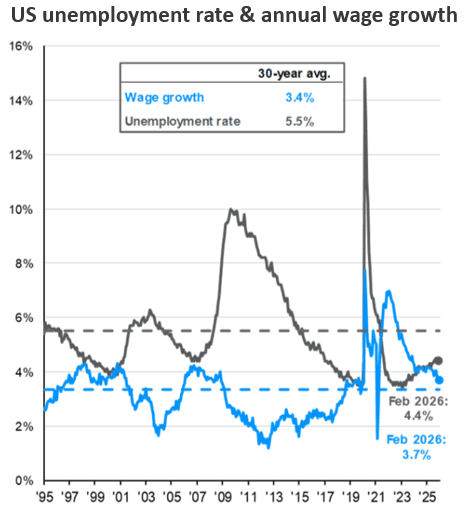
Job openings have declined, meaning workers have fewer options and less bargaining power, which in turn weighs on wages and consumer spending. Once unemployment begins to rise, it tends to do so quickly, and the feedback loop into consumer spending, corporate earnings, and market sentiment can be swift. A move higher from current levels would be a clear sign that the economy is heading into more difficult territory, but for long-term investors, if it happens, it would just be another thing to look through, with sensible portfolio management being the most reliable tool for navigating the journey.
Job openings have declined, meaning workers have fewer options and less bargaining power, which in turn weighs on wages and consumer spending. Once unemployment begins to rise, it tends to do so quickly, and the feedback loop into consumer spending, corporate earnings, and market sentiment can be swift. A move higher from current levels would be a clear sign that the economy is heading into more difficult territory, but for long-term investors, if it happens, it would just be another thing to look through, with sensible portfolio management being the most reliable tool for navigating the journey.
Ciaran Carolan 07/04/2026
Ciaran Carolan 07/04/2026

At DFP, we offer financial management advice to individuals, charities, corporate partnerships and businesses, which is specifically designed around their individual circumstances.
Docal Ltd. t/a DFP Pension & Investment Consultants is regulated by the Central Bank of Ireland.
Registered Address: 1st Floor Quayside Business Park,
Mill Street, Dundalk, Co. Louth. Registered in Ireland, company registration number 390947
At DFP, we offer financial management advice to individuals, charities, corporate partnerships and businesses, which is specifically designed around their individual circumstances.
Docal Ltd. t/a DFP Pension & Investment Consultants is regulated by the Central Bank of Ireland.
Registered Address: 1st Floor Quayside Business Park,
Mill Street, Dundalk, Co. Louth. Registered in Ireland, company registration number 390947
At DFP, we offer financial management advice to individuals, charities, corporate partnerships and businesses, which is specifically designed around their individual circumstances.
Docal Ltd. t/a DFP Pension & Investment Consultants is regulated by the Central Bank of Ireland.
Registered Address: 1st Floor Quayside Business Park,
Mill Street, Dundalk, Co. Louth. Registered in Ireland, company registration number 390947